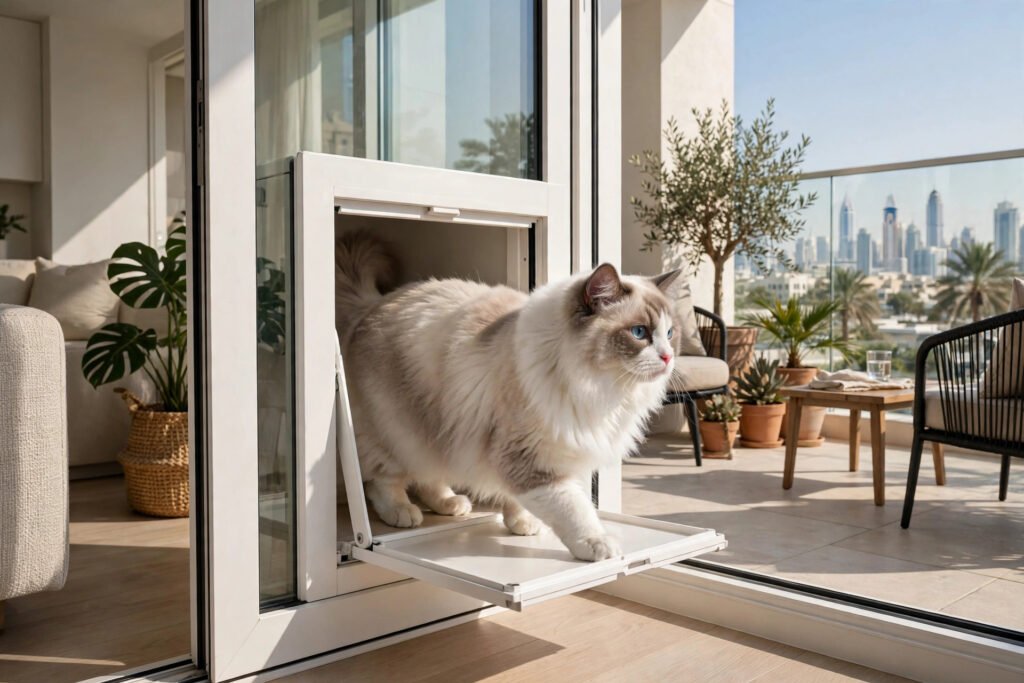
For many apartment cats in Dubai and Abu Dhabi, the balcony is the most interesting room in the home — and the litter box is the one thing their owners would most like to move out there. A cat flap fitted in a sliding window or balcony door insert solves both problems at once: your cat comes and goes to an enclosed balcony on its own, and the litter tray, the odour and the scattered litter stay outside your living space.
Why apartment cats end up on the balcony
Apartment living suits cats well, but it creates one daily friction point. A cat that cannot get outside at will depends on you for every trip, and a litter box kept indoors shares its smell with the whole flat. An enclosed or netted balcony changes the equation. It gives the cat fresh air, a view and a patch of territory of its own, and it gives you a ventilated, washable space for the litter tray that is not your bathroom floor.
That is why so many of the enquiries behind our apartment balcony and window cat doors come from residents in areas such as Dubai Marina, JLT, Downtown and Business Bay in Dubai, and Reem Island in Abu Dhabi. The pattern is the same in most towers: a sliding balcony door or a wide sliding window, a balcony that is already enclosed or netted, and a cat currently scratching at the glass to be let in and out.
How a sliding window or balcony insert works
The fitting does not cut your existing door or window. Instead, a made-to-measure insert panel sits in the sliding track of your balcony door or window, and the cat flap is mounted in that insert. The sliding panel closes against the insert, your cat pushes through the flap, and the original door or window panel is left completely untouched.
Because nothing is cut, the arrangement works in a wide range of openings:
- Full-height sliding balcony doors, where the insert runs in the door track
- Sliding windows, where a shorter insert carries the flap at floor level for the cat
- Openings where the litter enclosure sits on the balcony side, so the cat passes straight to its tray
The insert is measured for your specific track, which is why a photograph and a track measurement are the starting point for every fitting.
Litter box outside, odour outside
The most common layout is simple. The litter tray moves into an enclosed cabinet or a sheltered corner of the balcony, and the flap gives the cat a private route to it. The benefits are practical rather than glamorous: litter odour is ventilated outdoors instead of perfuming the flat, tracked litter stays on the balcony where it can be swept in seconds, and guests no longer share the room with the tray.
A few placement points make the setup work better. Keep the tray out of direct afternoon sun, because a covered tray in full UAE summer sun becomes unpleasantly hot inside. Place it where the cat can reach it without crossing the whole balcony if the floor is too hot for paws at midday.
Heat, AC and sealing: the apartment concern
The obvious question in the UAE is what a hole in the door does to your air conditioning. A sliding door left ajar for a cat is a serious AC leak; a correctly sized flap in a sealed insert is a different matter entirely. The insert is fitted to close the track opening around the flap, and the flap itself closes behind the cat, so the exchange of air is brief and small compared with opening the door repeatedly through the day.
This is also why flap quality matters in this climate. A flap that warps, sticks or fails to close fully will leak cooled air all summer. We fit recognised brands — SureFlap and PetSafe for microchip and manual models, and Closer Pets for manual four-way locking flaps — chosen to keep closing properly in the heat.
Choosing the right flap: size first, then features
Size comes before electronics. The rule we apply on every cat fitting is straightforward: any cat over 4 kg needs a Large flap. That includes many British Shorthairs, Ragdolls, Maine Coons and well-built adult Arabian Maus. A standard flap that is too small is the main reason cats hesitate, squeeze or stop using a flap altogether, so we size for the cat you have, not the kitten it once was.
Once the size is right, the choice is between:
- Manual four-way locking flaps, which you can set to in-only, out-only, fully open or fully locked — useful for keeping a cat in overnight or during cleaning and maintenance visits
- Microchip flaps from SureFlap and PetSafe, which read your cat’s existing veterinary microchip and open only for your cat — the right choice where other cats in the building might otherwise wander in
Closer Pets models are supplied for manual four-way locking only, so if selective entry matters, the microchip route is SureFlap or PetSafe.
Rental-friendly: no cutting, no landlord NOC
Most apartment tenants assume a cat flap is impossible in a rented flat. With an insert, it is not. Because the flap lives in a removable insert panel rather than in your landlord’s glass, nothing is cut and no landlord NOC is needed. The same rental-friendly principle runs through our glass work: where a flap goes into a glass panel instead, we store your original glass and swap it back in 30 minutes when you move out.
For an insert, moving out is simpler still — the insert comes out of the track and the door returns to exactly how it was. That makes this one of the few genuine improvements a tenant can make without a deposit conversation at the end of the lease.
Frequently asked questions
Can a cat flap really go in a sliding window, not just a door?
Yes. A shorter insert panel sits in the window track with the flap at the cat’s level. It suits flats where the balcony is reached through a wide sliding window rather than a full-height door.
Will a balcony flap let the heat in and the AC out?
Not in any meaningful amount when the insert is properly measured and sealed. The flap opens briefly for the cat and closes behind it, which loses far less cooled air than propping a sliding door open.
My cat weighs over 4 kg. Does that change anything?
Yes — it needs a Large flap. Cats over 4 kg, including most British Shorthairs, Ragdolls and Maine Coons, can find a standard flap too tight and may refuse it, so we size up from the start.
Is this allowed in a rented apartment?
The insert does not cut or alter your existing door or window and needs no landlord NOC. It is removed at move-out, leaving the opening as it was.
Should the litter box go straight onto an open balcony?
The flap should lead to an enclosed or netted balcony, so the cat stays safely within your own space. A sheltered corner or enclosed litter cabinet on that balcony keeps the tray dry, shaded and easy to clean.
Talk to us about your balcony or window
Send us a photo of your sliding door or window on WhatsApp at +971 52 443 2655, tell us your area and your cat’s approximate weight, and we will advise on the right insert and flap size. You can also email us at admin@petdoorfix.com. We install across all seven UAE emirates, and we will tell you honestly if your opening is not suitable before you commit to anything.