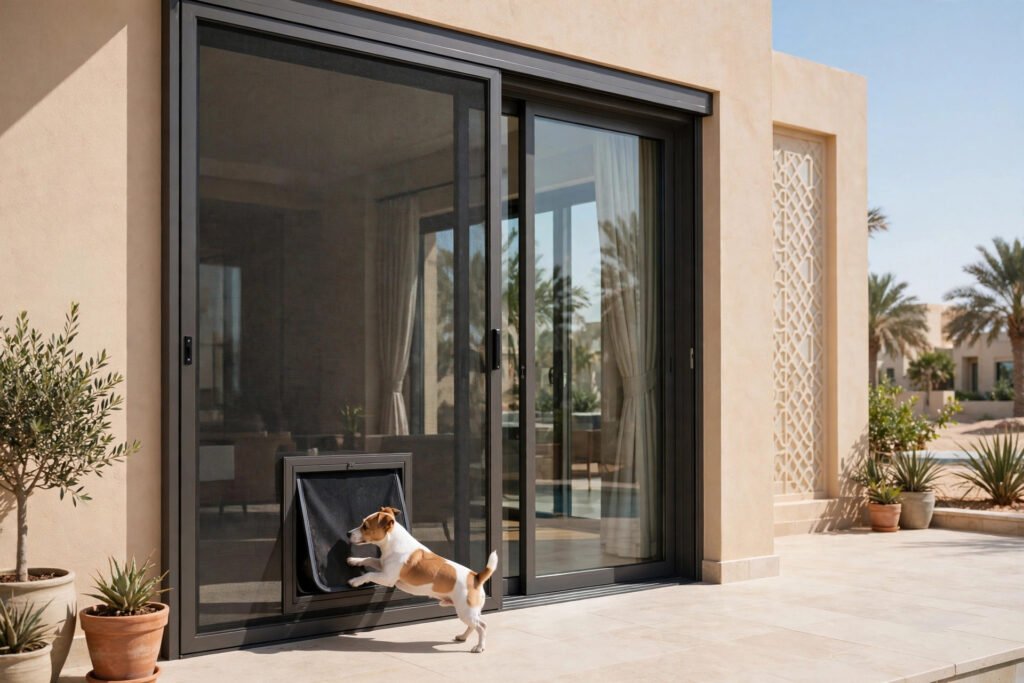
Many UAE villas have two doors where you might expect one: an outer sliding fly-screen door that keeps insects out while the breeze comes in, and an inner glass sliding door behind it. If your dog or cat needs to come and go, both layers are in the way — so yes, a pet flap can go into a screen door, but it works best as a planned dual-flap setup through the screen and the glass, not as a hole cut in mesh on its own.
Why a screen door is not like a glass door
Mesh is flexible, and that is the whole difficulty. A flap is a rigid frame with a moving door inside it, and it needs solid support on all four sides. Fixed straight into unsupported mesh, a flap frame would flex every time a pet pushes through, the mesh around it would fray and tear, and within weeks you would have a gaping hole that lets in every fly and mosquito the screen was there to stop.
That is why our approach to fly-screen pet door installation starts with support, not with the flap. The opening in the screen is finished with a firm frame that the pet flap mounts into, so the mesh stays taut, the frame stays rigid, and the flap opens and closes the way it was designed to.
The dual-flap setup: screen and glass in line
In most villas, fitting only the screen achieves nothing, because the glass door behind it is still closed. The working arrangement is two flaps, one in the screen door and one serving the glass door, aligned at the same height and in the same position so your pet walks a straight line through both.
For the glass side, the flap is normally carried in a sliding door insert or in a replacement glass panel, depending on your door. For the screen side, the flap sits in its framed opening in the mesh. Alignment matters more than it might sound: if the two flaps are offset, a dog has to twist between them and a cat will often simply refuse. Set at the same step-over height and directly opposite each other, pets treat the pair as a single doorway and learn it quickly.
Step-over height is part of the same calculation. The bottom of the flap should sit low enough for your pet to step through comfortably without jumping or crouching, while the top of the opening clears its back with room to spare.
Sizing for dogs and cats
Screen-door enquiries are usually about dogs, and dog sizing follows fixed flap dimensions. Our dog door sizes are Medium at 23×35 cm, Large at 28×45 cm and X-Large at 36×65 cm. As a guide, Medium suits smaller, stocky breeds such as Shih Tzus and Poodles, Large suits mid-sized dogs such as Beagles and Pointers, and X-Large is for big dogs such as Labradors, Golden Retrievers, Huskies and Great Danes. We confirm the size from your dog’s shoulder height and width before fitting, because a flap that is too small will not be used and one that is far too large is harder to seal.
Cats use screen flaps too, particularly where the screen is the only barrier to a shaded terrace. The cat rule is the same as everywhere else: any cat over 4 kg needs a Large flap, which covers most British Shorthairs, Ragdolls and Maine Coons.
Brand choice follows the job. For dog doors we fit Hakuna Pets and PetSafe, whose magnetic seals pull the flap shut behind the dog and keep it shut. For cats, SureFlap and PetSafe cover microchip and manual models, and Closer Pets is supplied for manual four-way locking flaps only. Where stray cats are a problem, selective entry is handled on the glass side with a microchip flap, while the screen flap remains a simple, free pass-through.
Keeping insects, dust and cooled air where they belong
A screen door has one job — ventilation without insects — and a badly fitted flap undoes it. Two details protect it. First, the framed opening must be sealed properly to the mesh and the door frame, with no loose edges or gaps at the corners for insects to find. Second, the flap itself must close fully after every pass. A flap that hangs slightly open is an open door to mosquitoes in the evening and a steady leak of cooled air whenever the inner glass door is the open layer.
The surrounding mesh also takes more wear once a flap is fitted, because paws and claws land around the opening as pets aim for it. Reinforcing the mesh area around the frame, and using a heavier pet mesh where the original screen is worn or torn, stops the opening from becoming the weak point of the whole door.
Which villas suit a screen flap?
The setup suits any villa or townhouse where a sliding fly-screen runs in its own track outside a sliding glass door — a very common arrangement across Dubai and Abu Dhabi. It is worth telling us at the enquiry stage whether your screen is a sliding panel or a hinged screen, what condition the mesh is in, and whether you also need the glass side fitted, because the screen flap on its own only makes sense when the glass layer is dealt with at the same time.
If your property is rented, the glass side of the work follows our usual rental-friendly approach: your original glass is stored safely and can be swapped back in 30 minutes when you move out, with no landlord NOC needed.
Frequently asked questions
Can you cut a flap straight into the mesh?
Not on its own. Mesh cannot support a flap frame — it flexes, frays and tears. The opening needs a firm frame fitted into the screen first, and the flap mounts into that frame.
Do I need a flap in the glass door as well?
Usually, yes. Most villa screens sit outside a glass sliding door, so the pet has to pass both layers. We align a flap in the screen with a flap serving the glass, at the same height and position, so the pet walks straight through.
Will a screen flap let mosquitoes and flies in?
A properly framed and sealed opening should not. The frame is sealed to the mesh with no gaps at the corners, and the flap closes behind your pet. A flap left hanging open would be a problem, which is why we fit flaps that close positively, including magnetic-seal dog doors from Hakuna Pets and PetSafe.
What size does my dog need?
Medium is 23×35 cm, Large is 28×45 cm and X-Large is 36×65 cm. Send us your dog’s breed and shoulder height on WhatsApp and we will confirm the right size before fitting.
My cat is large. Can it use the screen flap too?
Yes, provided the flap is sized correctly. Cats over 4 kg need a Large flap, and the screen and glass flaps are aligned so the cat passes through both in one line.
Book a fly-screen pet door fitting
Message us on WhatsApp at +971 52 443 2655 with a photo of your screen door and the glass door behind it, plus your pet’s breed and approximate size. You can also email admin@petdoorfix.com. We install across all seven UAE emirates and will confirm the right dual-flap arrangement for your villa before booking you in.