
A pet door is, by definition, a hole in your home’s envelope — and in the UAE, where the air conditioning runs for most of the year and fine dust arrives on every shamal breeze, owners are right to ask how well that hole is sealed when it is not in use. The answer lies in the layers of sealing around a properly built insert. This article explains weather-sealed sliding pet inserts layer by layer: where air tries to escape, what stops it, and the honest limits of sliding insert weather sealing when the flap itself is designed to open.
Where the air actually tries to get out
An insert panel has four edges, and each one is a potential leak. The vertical edge where your sliding door closes against the insert is the busiest — it opens and closes daily. The head and sill, where the insert stands in the top and bottom of the track, are static once fitted but must cope with tracks that are rarely perfectly true. And then there is the flap opening itself, the largest single gap in the panel when it hangs ajar.
Air follows pressure and path. Cooled indoor air is denser and the house is constantly exchanging air with a far hotter exterior, so any unsealed edge quietly bleeds the air you have paid to cool, and draws dust in as it goes. A cheap or poorly fitted insert leaks at the panel edges; a well-made one treats every edge as part of the design.
Sliding insert weather sealing, layer by layer
Brush seals along the meeting edge
Where the sliding door meets the insert, a rigid seal would bind or wear within weeks. Instead, this edge uses brush or pile weatherstripping: a dense strip of fine bristles held in a finned carrier. The door closes into the brush, the bristles flex around it, and the result is a seal that tolerates daily sliding while blocking the direct path for air and dust. It is the same principle your sliding door’s own factory seals use, extended to the insert.
Compression seals at the head and sill
The top and bottom of the insert do not move once fitted, so they can use soft compression seals — foam or rubber that is lightly squeezed when the panel is seated in the track. Compression is what makes these edges forgiving: the seal deforms to follow small irregularities in older tracks instead of leaving a hard gap wherever the aluminium is a fraction out.
The flap’s own seal
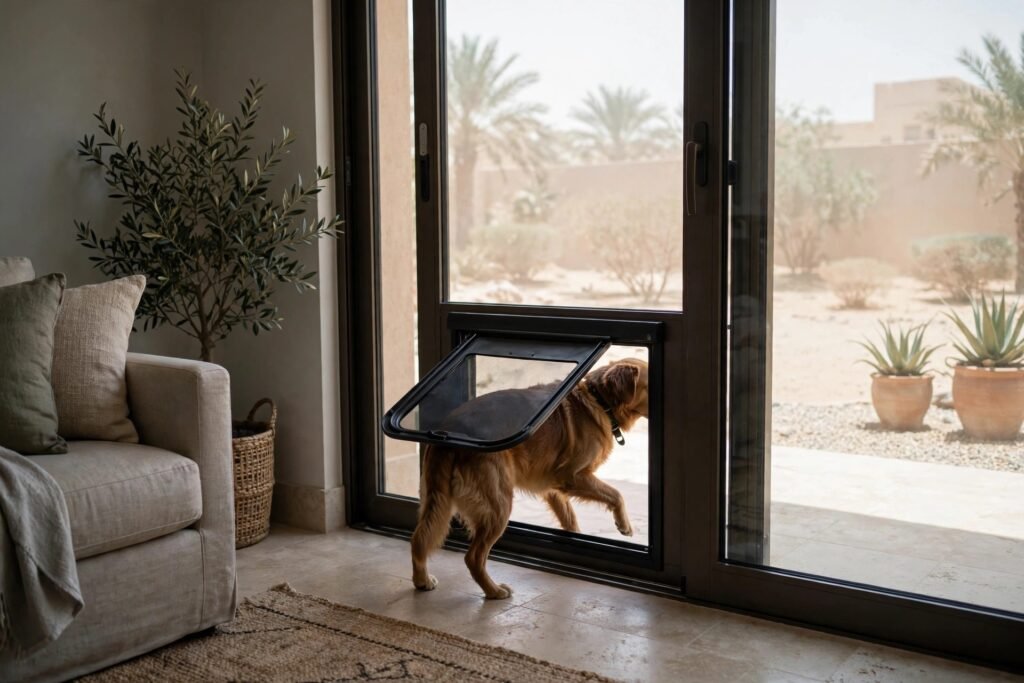
The flap is the moving part, and its seal matters most of all because it is the biggest opening. Dog doors from Hakuna Pets and PetSafe use a magnetic seal: magnets along the flap’s edge pull it closed and hold it against its frame after every pass, so it does not hang open or swing in a draught. Cat flaps likewise close positively against their frames rather than resting ajar — microchip models from SureFlap and PetSafe latch as they close, and manual four-way locking flaps, including Closer Pets, shut flush against their frames. A flap that closes fully, every time, is the difference between a pet door and a vent.
Dust, sand and the shamal
UAE dust is not like household dust elsewhere. It is fine, mineral and persistent, and it arrives suspended in hot air looking for any inward path. Sealed edges deal with most of it: brush seals are particularly good against dust because the bristle bed traps particles rather than offering them a clean channel. What dust does get in tends to arrive through use — on paws, and in the seconds the flap is open — rather than through the seals. The practical defence is maintenance: dust also accumulates in the track itself, and a track full of grit can stop both the door and the insert seating properly, which is why keeping the track clean is part of keeping the seal working.
The honest limits
No pet door seals like a wall, and anyone who tells you otherwise is selling something. When your pet goes through, hot air and a little dust come with it — that is physics, not a defect. What good sealing changes is everything that happens in the other twenty-three hours and fifty-nine minutes of the day: the flap shut and held by its magnets, the panel edges closed by brush and compression seals, the cooled air staying where it belongs. It is also worth saying that a badly fitted insert undermines all of this at once, because the seals are designed around a panel built to the measured height and depth of your track. Sealing is a property of the whole installation, not a strip you can add later.
Frequently asked questions
Will an insert push my AC bills up noticeably?
A correctly fitted, sealed insert is designed to keep that effect minimal: the panel itself is glass and aluminium like the door it joins, and the flap seals shut behind your pet. An open door or a window left ajar loses far more cooled air. A poor fit is what costs money, which is why the measuring stage matters.
Do the seals wear out, and can they be replaced?
Brush and foam seals are wear items over years of use and UAE heat, and yes, they can be renewed without replacing the insert. If you start to feel a draught at the meeting edge or see light through a closed edge, that is the sign to ask us to look at the seals.
Does the magnetic flap seal work for cats too?
Magnetic closing is a feature of the dog doors we fit from Hakuna Pets and PetSafe. Cat flaps close against their frames under their own design — microchip models from SureFlap and PetSafe latch as they close — and correct fitting keeps them sitting flush rather than ajar.
What about rain driving against the door?
The insert’s exterior faces are glass, aluminium and the same seal types your door already relies on, so wind-driven rain is handled the same way your sliding door handles it today. If your door currently lets water in at the track in heavy rain, tell us — that is a track issue we should know about before fitting.
Will sealing make my sliding door harder to close?
It should not. Brush seals are chosen for the meeting edge precisely because the door has to slide against them daily. A door that suddenly needs force after fitting is a sign something is misaligned, and it should be adjusted, not accepted.
Ask us how your door will seal
Every door seals a little differently, because every track does. WhatsApp a photo of your sliding door and its track to +971 52 443 2655 and we will explain how sliding insert weather sealing would work on your specific door before you commit. Prefer email? Write to admin@petdoorfix.com. We fit sealed inserts across Dubai, Abu Dhabi and all seven UAE emirates.
Instant WhatsApp Photo Quote
Send a photo of your door, your pet's size, and your area.
WhatsApp Photo QuoteNext guide: Moving House? Taking Your Sliding Pet Insert With You