Glass gets most of the attention in UAE pet doors, but plenty of homes route the pet somewhere else entirely: through the fly-screen, through a solid back door, or through the wall itself. Choosing between them means weighing up a screen vs wood vs wall pet door properly, not just picking whichever seems easiest. If you are choosing screen, wood or wall for a pet door, this is the comparison we work through with owners, because the three surfaces differ in the one way that matters most — what is left behind when the flap comes out. One of them is barely an alteration. Two of them are permanent. Knowing which is which, before anyone picks up a tool, is the whole decision.
The three surfaces, briefly
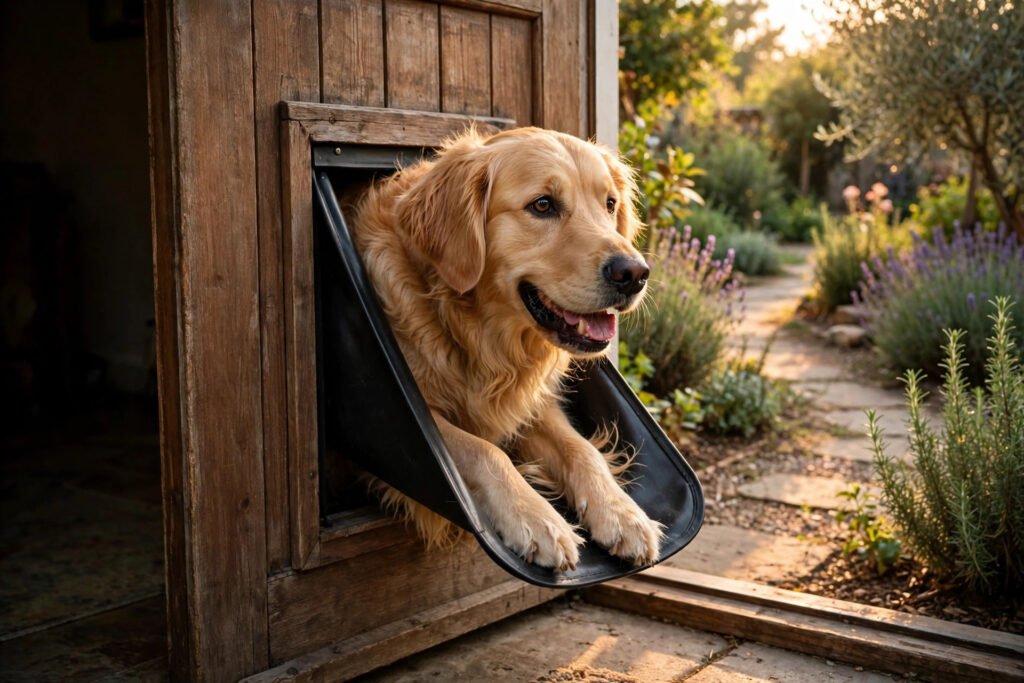
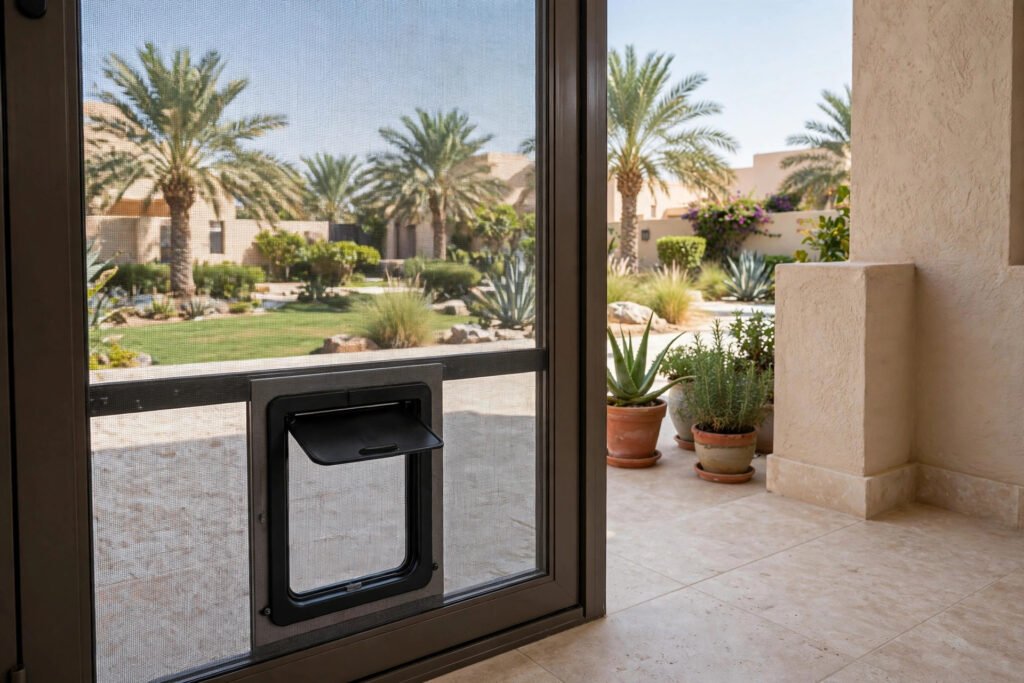
A screen fitting puts a framed opening into a fly-screen door or panel. The screen already exists to be opened and closed; the flap is framed into the mesh so the mesh stays taut and the insects stay out. A wooden door fitting mounts the flap in the door leaf itself — the classic cat flap in the back door, scaled up to dog sizes where the door suits it. A wall fitting forms an opening through the wall, lined with a tunnel and a flap at the end, for homes where no door is in the right place.
All three end with a pet using a flap. Everything before that point — cutting, permanence, suitability — is where they part company.
Screen vs wood vs wall pet door: permanence and reversibility
Start with the screen. A screen panel is a consumable part of the house: panels are re-meshed, repaired and replaced as routine maintenance. A flap framed into a screen can be removed and the panel re-meshed or replaced, and where the screen pairs with a glass door, the glass side follows our reversible approach. Of the three surfaces, the screen is the only one a renter should even discuss — and even then, only as part of a combination that leaves the property as it was found.
Wood is permanent for that door. The leaf is cut to the flap’s outline; take the flap out and the door still has a flap-shaped hole until it is filled, patched or replaced. A wall is the most permanent of all: the opening goes through blockwork and render, and removing it later is a builder’s filling and finishing job, not a swap-back.
Set that against our glass standard — original glass stored uncut, swapped back in 30 minutes, no landlord NOC — and the rule writes itself: tenants choose glass or glass-and-screen combinations; owners may choose any surface with their eyes open.
What drives the work on each route
No figures here, because the honest answer is “it depends”, but the drivers are consistent. On a screen, the work turns on the condition of the mesh and frame, and on whether the glass behind it also needs a flap aligned with it. On wood, it turns on the door itself: a solid door takes a flap cleanly, a hollow-core door needs more care, and raised panels or mouldings can rule a position in or out. On a wall, the drivers are the wall’s thickness and construction, the tunnel length it demands, and the finishing — render and paint inside and out. Complexity, fabrication and finishing drive the effort on every route; the surface decides which of them you are paying attention to.
Which surface suits which home
Renters, as established, belong on glass — with a screen flap added only where the glass layer is handled reversibly at the same time. Owners of villas with a solid back or utility door often find wood the simplest answer of all: the door is in the right place, the flap goes in it, done. Owners whose doors are all glass, in the wrong rooms, or who want the flap in a utility room or garage wall are the natural wall customers. Large dogs push the decision too: X-Large flaps at 36×65 cm need a surface that takes them comfortably, which usually means a substantial door leaf or a wall, while screens suit cats and smaller dogs best. The 4 kg rule applies on every surface — a cat over 4 kg needs a Large flap.
Frequently asked questions
Which surface is the most renter-friendly?
The screen, and only in combination with a reversible glass fitting behind it — on its own a screen flap achieves little if the glass door behind stays shut. Wood and wall are permanent alterations and belong to owners. The fully rental-friendly standard is glass: original panel stored, swapped back in 30 minutes.
Which is the least disruptive to fit?
A screen fitting disturbs the house least, followed by a wooden door. A wall opening is the biggest job of the three — it is the only one that makes real construction dust, which is another reason its position should be chosen once and chosen well.
Can a large dog use any of the three?
Dog sizes run Medium 23×35 cm, Large 28×45 cm and X-Large 36×65 cm. A solid wooden door or a wall handles the X-Large comfortably. A screen is generally the wrong surface for a big, enthusiastic dog — the mesh around the frame takes the strain of every pass.
Can surfaces be combined in one home?
Yes, and often are: a screen flap aligned with a glass fitting is the standard villa combination, and some homes have a wall door for the dog and a door flap for the cat. Each surface is chosen on its own merits per opening.
Which surface keeps the weather out best?
A wall tunnel with a flap at each end seals superbly, and a wooden door flap with magnetic seals performs like any good pet door. A screen, by design, is a ventilated layer — its flap keeps insects out, but the weather barrier in a screen combination is always the glass door behind it.
Send us the surface, we’ll advise
Still weighing up a screen vs wood vs wall pet door for your home? Send photos of the door, screen or wall you have in mind, plus your pet’s breed and size, on WhatsApp at +971 52 443 2655. We will tell you which surface suits — including when the honest answer is glass instead — or email admin@petdoorfix.com. We install across all seven UAE emirates.
Instant WhatsApp Photo Quote
Send a photo of your door, your pet's size, and your area.
WhatsApp Photo QuoteNext guide: Thick Walls, Deep Tunnels: Pet Doors for Chunky UAE Villa Walls