
Pick up a standard pet door kit and its tunnel will span a door, or a modest wall. Then measure a UAE villa wall: an inner leaf of blockwork, a cavity, an outer leaf, render outside and plaster inside. The tunnel in the box is nowhere near long enough, and a flap mounted at one face leaves the pet squeezing past raw, unfinished wall through the rest. Fitting a pet door for thick walls comes down to the tunnel. Deep walls are exactly why tunnel extensions for thick walls exist — sections that join to build the tunnel out to the full depth of your wall, so the passage is lined, smooth and sealed from room to garden.
Why villa walls defeat a standard tunnel
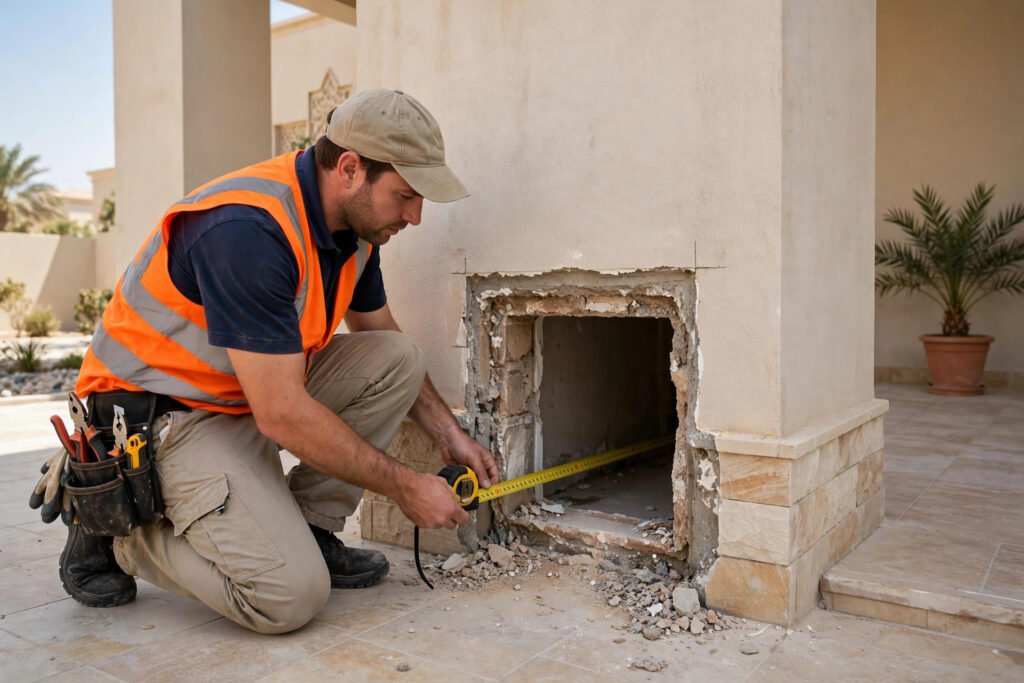
Wall construction here is built for heat. Thick masonry, cavities and heavy render keep the worst of the summer out, and the total depth of a finished external wall surprises most owners when it is measured — far beyond the tunnel supplied with a flap designed for a timber door. The depth varies around a single house too: a wall with external insulation or cladding, a rendered feature wall, or an older wall that has been re-skimmed can each measure differently. That is why the survey measures the actual wall at the actual position rather than assuming a standard depth.
Fitting a pet door for thick walls
The method follows the measurement. The opening is formed through the wall, then the tunnel is built up from sections joined to match the measured depth precisely — no gap at the far end, no tunnel protruding into the room. The sections are fixed so the lining is continuous, with no ledge or lip at the joins for a shoulder or collar to catch on. The flap mounts at the inner face (and at the outer face too, on double-flap arrangements), and both ends are sealed and trimmed.
One detail matters more in a deep tunnel than a shallow one: drainage and dust. The tunnel floor is finished smooth and very slightly falls toward the outside, so wind-driven rain that gets past the outer flap runs out rather than pooling, and a wipe with a cloth is all the housework the tunnel ever asks for.
Tunnel length and your pet
A long tunnel asks a little more of the animal. To a dog it is a short corridor; to a cautious cat it is a dim tube with daylight at the end, and some cats hesitate the first few times. Size helps: the opening sizes are unchanged — dog doors at Medium 23×35 cm, Large 28×45 cm and X-Large 36×65 cm, and cats over 4 kg in a Large flap — but the pet must commit to the full depth, not just pop a head through a door.
Training is simple and quick. Start with the flap held fully open and treats at the far end, let the pet walk the tunnel for the treats a few times, then lower the flap so each pass earns the same reward. Most pets are trotting through within a day. If the tunnel is deep and the pet is nervous, a second flap at the outer end is better added once the pet is confident, so there is only one new thing to learn at a time.
Sealing a deep tunnel
Every join is a potential draughty gap, and a deep tunnel has more joins than most. Sealing therefore happens along the whole build: the sections are joined tightly, the perimeter at both wall faces is sealed, and the exterior gets the full weather treatment — flashing and sealant where the trim meets the render — because the outer opening faces shamal dust and driving rain. The payoff of a flap at each end is insulation: the still air trapped in the tunnel between the two closed flaps does the same job as the cavity in the wall itself.
Frequently asked questions
How thick is too thick for a wall pet door?
In practice very few villa walls defeat the method — tunnel sections keep joining until the depth is spanned. Extremely deep or unusual constructions are a survey conversation, but ordinary thick UAE villa walls, including rendered and insulated ones, are routine.
Will my cat really use a long tunnel?
Yes, once it has learned the route. Cats are cautious with the dim middle section at first, so we recommend training passes with the flap held open and treats at the far end. Confident use usually follows within a day or two.
Can the tunnel be extended later if the wall changes?
If the wall is built out — external insulation or cladding added, for instance — additional tunnel sections can extend the lining to the new depth. The flap position and sizes stay the same; it is the sleeve that grows.
Does a longer tunnel lose more cooled air?
Slightly more than a thin door, yes, which is why deep tunnels pair naturally with a flap at each end: the airlock between them limits the exchange to the tunnel’s own volume, and magnetic seals keep each flap properly shut between passes.
Can a microchip flap work on a deep tunnel?
The reader sits in the flap unit, so the flap should be mounted where the pet’s chip passes close to it as it enters the tunnel — we position the selective-entry unit from SureFlap or PetSafe at the appropriate end and confirm the model against your wall depth before fitting.
Measure the wall, then decide
Planning a pet door for thick walls starts with one number: the true depth of the wall at the spot you have in mind. Send us photos of the wall inside and out, with your pet’s breed and size, on WhatsApp at +971 52 443 2655 and we will talk you through the tunnel it needs — or email admin@petdoorfix.com. A wall fitting is permanent, so it is an owner’s route; renters, ask us about the reversible glass options instead.
Instant WhatsApp Photo Quote
Send a photo of your door, your pet's size, and your area.
WhatsApp Photo QuoteNext guide: Double-Flap Wall Doors: Two Flaps, One Tunnel, Better Insulation