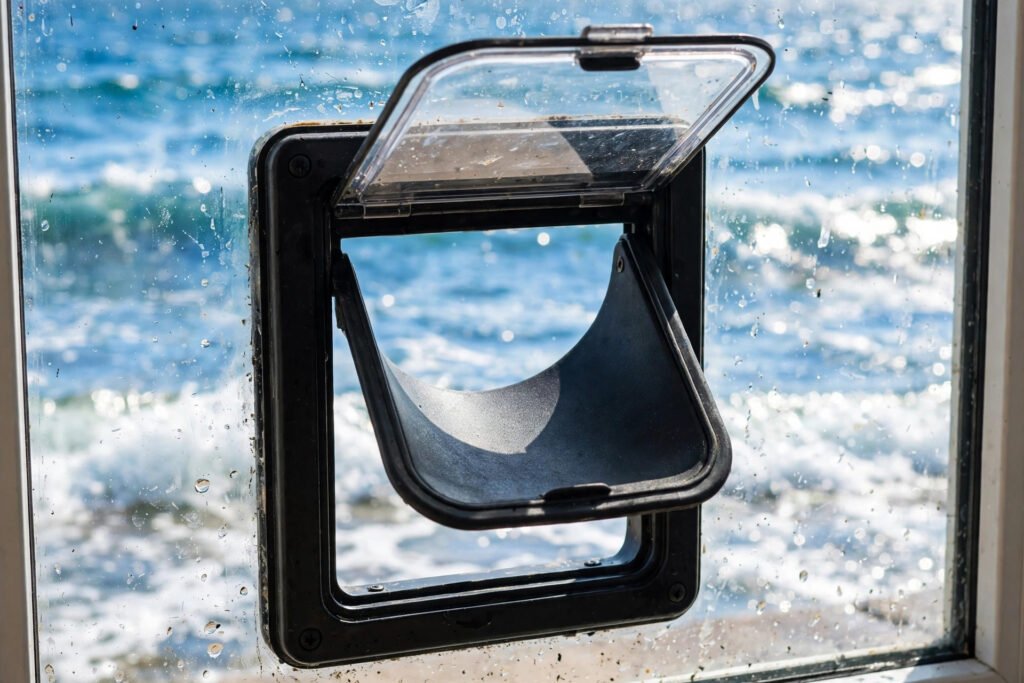
A pet door on the East Coast works in conditions a pet door inland never meets. In the coastal homes of Al Aqah, Dibba and Kalba, the air itself is the challenge: humid for much of the year, carrying salt, and pushed onshore by breezes that test every seal in the house. Owners asking about weather-sealed pet doors in Fujairah are usually asking a practical question — will the flap actually stay shut and sealed here, or will it rattle, leak cooled air and slowly suffer in the salt air?
Honest answer: it depends on three things — how the flap latches, how the frame is finished, and how the unit around it is sealed. Pet door weather sealing Fujairah’s coast demands is really those three checks, done properly. This guide walks through each.
Pet Door Weather Sealing Fujairah Check One: A Flap That Latches
The weakest pet doors rely on the flap’s own weight and a flexible hinge. Inland, in still air, that can pass. On the coast it cannot: a breeze lifts a hanging flap, and once lifted it flaps — letting in humid air, dust and insects, and wearing its own edges out in the process.
What you want instead is a flap that is pulled positively shut and held. Magnetic sealing does this work: magnets set into the flap and frame draw the flap closed after every pass and keep it latched against ordinary wind pressure. It is the standard we fit by — Hakuna Pets dog doors are built around a magnetic seal, and the cat flaps we fit from SureFlap and PetSafe close positively rather than hanging loose. When you are comparing flaps for a coastal home, the first test is simple: push the flap and let go. It should close with a small, definite click and stay closed when you press lightly against it.
Check Two: The Frame Finish
Salt air is unkind to bare and cheaply finished metal — it dulls, pits and eventually corrodes it, and a pet door frame sits in the most exposed part of the house, at pet height, in the glass line. The frame finish is therefore a sealing issue as much as a cosmetic one, because a frame that corrodes around its edges stops meeting the glass and seals cleanly.
Our frames are aluminium, powder-coated — the standard white finish, or a custom RAL colour matched to your existing frames — and powder-coating is a sensible finish for the coast because it coats the metal completely rather than leaving it bare. At enquiry, it is worth telling us your home is coastal: not because the product changes, but because the fitting checks around the frame edge deserve particular care in salt air.
And the fixings and seals around it
A frame is only as weatherproof as its perimeter. The panel or insert carrying your flap is sealed into the door frame or track as part of the fitting, and those perimeter seals are what stand between the sea air and your interior. On an exposed East Coast elevation, we pay attention to the sheltered-versus-exposed choice too: where the layout offers a panel slightly protected by the building’s own walls, it will always weather better than the most exposed pane.
Check Three: Sealed Units, Not Gaps
Where a flap is fitted into glazed panels, the unit itself should be a proper sealed unit — the replacement panel is fabricated as a complete tempered unit with the flap mounted in it, not a piece of glass with a hole surrounded by improvisation. Sealed construction matters doubly on the coast: humid air finds any path into a badly made unit, and a unit that mists or admits moisture at its edges will not improve with time.
This is also why the glass route suits coastal homes. The flap is never cut into your existing toughened glass — that cannot be done — so you are not left with a raw, hand-finished edge exposed to the weather. You get a factory-finished panel, sealed as a unit, with the flap’s own seals doing the moving part.
A Simple Care Routine for Coastal Flaps
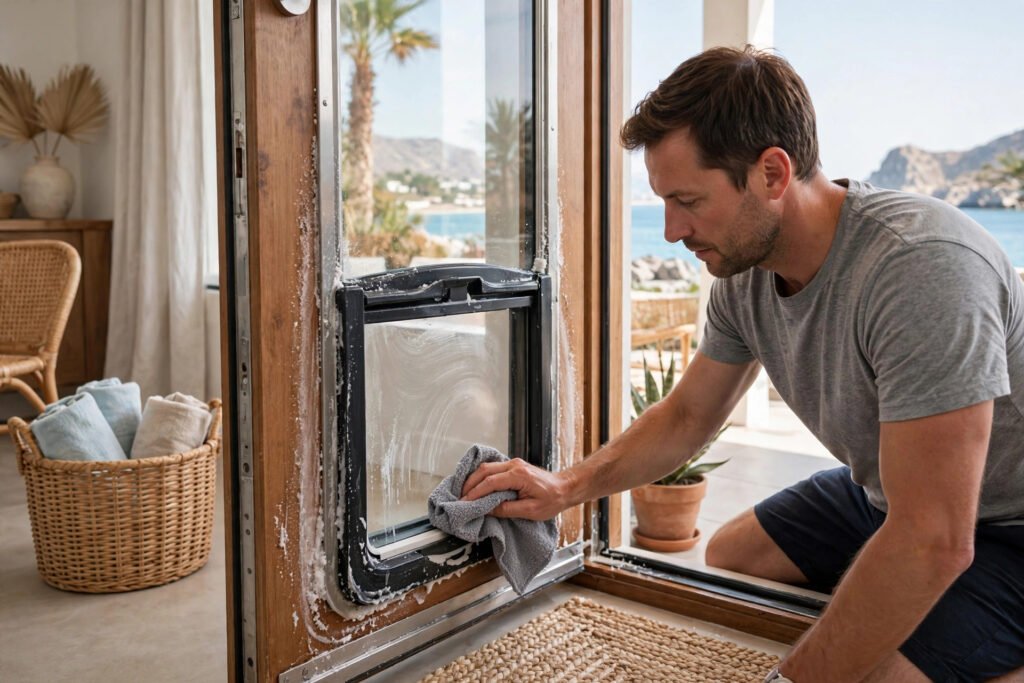
Good sealing lasts longer with small amounts of attention. Wipe the flap’s meeting edges and the magnetic strip occasionally — wind-blown dust and salt film on the seal faces weaken the latch’s grip over time. Rinse grit from the bottom edge of the flap after stormy, sandy weather rather than letting it grind in the hinge. And check, once in a while, that the flap still closes with its click; a seal that has stopped latching is telling you something early, while it is still a small thing.
None of this is burdensome — it is the same two-minute attention you would give the seals on the doors themselves, in a house where the sea air asks a little more of everything.
Frequently asked questions
Will humidity get inside a double-glazed unit with a flap?
Not in a properly made unit. The replacement panel is fabricated and sealed as a complete unit with the flap mounted in it, so there is no open path for moist air into the glazing cavity. Moisture inside a unit is a sign of a failed seal, not a normal consequence of having a flap.
Do magnetic seals really hold against sea breezes?
They hold against ordinary wind pressure, yes — that is what they are for. The magnets draw the flap shut and keep it latched, unlike a free-hanging flap that a breeze can lift. In genuinely extreme gusts any flap can be pressed, but it re-latches the moment the gust passes.
Is powder-coating worth it on the coast?
As a finish, yes: it coats the aluminium fully, which is what you want between metal and salt air. The standard white finish is powder-coated; custom RAL colours matched to your frames are powder-coated the same way.
My home is in Kalba. Does the coastal advice apply there too?
It does — Kalba’s homes sit on the same East Coast, with the same humid, salt-carrying air as Al Aqah and Dibba. The three checks in this guide apply to any home along this coastline.
Can you weather-seal a flap in my existing glass?
The flap is never cut into existing toughened glass. It is fitted in a replacement panel or a track insert, and the sealing is done as part of that fitting — the unit, the frame perimeter and the flap’s own latch together.
Talk to us about a coastal fitting
To discuss pet door weather sealing Fujairah’s coastline asks for, message us on WhatsApp at +971 52 443 2655 with photos of your door and a note of how exposed it is to the sea — Al Aqah, Dibba, Kalba or Fujairah city. You can also email admin@petdoorfix.com. Tell us it is a coastal home from the first message, and the specification we recommend will be built for the air it has to live in.
Instant WhatsApp Photo Quote
Send a photo of your door, your pet's size, and your area.
WhatsApp Photo QuoteNext guide: Double-Glazed Pet Doors in Fujairah Homes