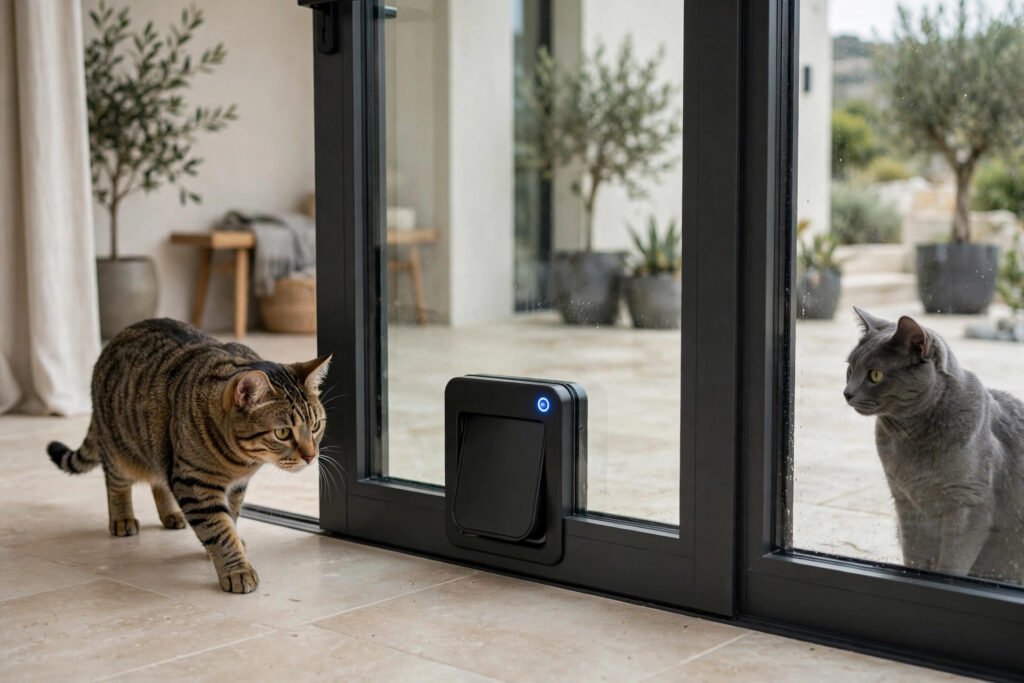
A standard cat flap lets every cat through, including the neighbourhood strays that wander into UAE villas to eat your cat’s food, spray indoors and pick fights. A microchip cat flap works differently: it reads the microchip your cat already has from the vet and unlocks for your cat alone, so your home stays open to your pet and closed to everything else. So how does a microchip cat flap work in practice? It reads the chip your cat already carries.
See our guide to microchip cat flaps for the full service.
The problem a microchip flap solves
Stray and neighbourhood cats are a daily reality in villa communities across Dubai and Abu Dhabi. A cat that finds food and shelter through an ordinary flap will treat your home as part of its territory, and once one cat starts visiting, the problem rarely solves itself. Owners usually try locking the flap at night, but that locks their own cat in or out as well, and it does nothing during the day.
Selective entry removes the compromise. The flap stays shut as a solid door to every animal except the ones registered to it, and your cat comes and goes as freely as it would through an ordinary flap.
How a microchip cat flap works, step by step
The technology is simpler than it sounds, and it uses identification your cat already carries.
Step 1: Your cat’s chip is registered to the flap
During fitting, your cat passes through or in front of the flap once so the reader learns its microchip number. That number is stored in the flap’s memory. Most flaps can store several cats, so multi-cat households register each cat the same way.
Step 2: The reader scans as your cat approaches
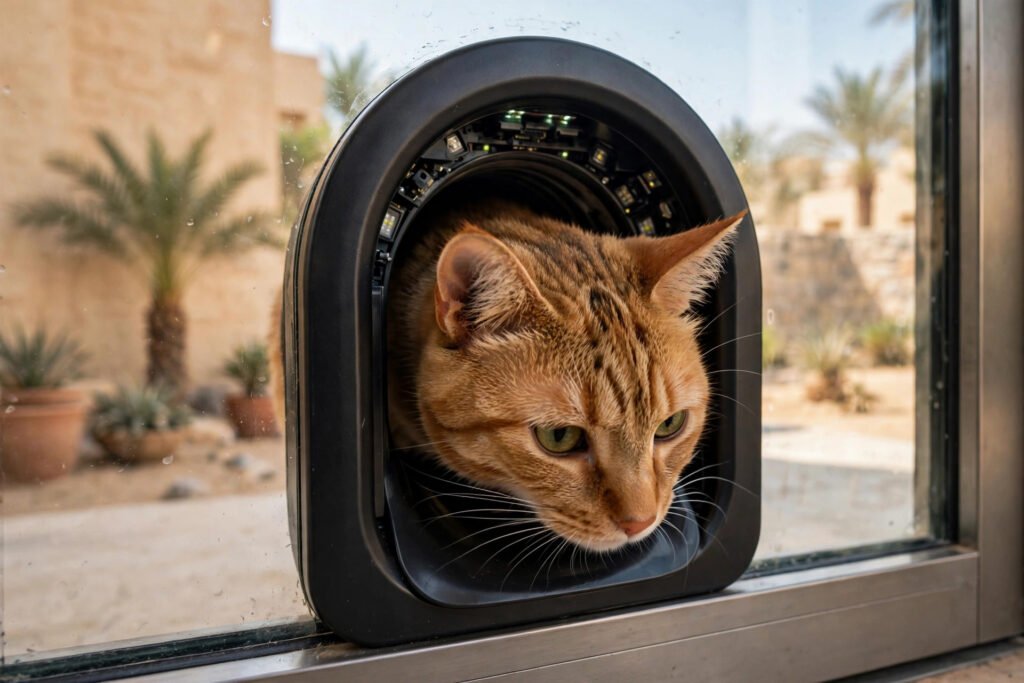
A sensor in the flap reads the chip as your cat puts its head towards the opening. The chip sits under the skin, usually between the shoulder blades, which is exactly where the reader is positioned to pick it up.
Step 3: The flap unlocks only for a recognised chip
If the number matches one stored in the memory, the lock releases and your cat pushes through. If an unregistered cat tries, the lock stays engaged and the flap does not move — no entry for strays, neighbours’ cats or other visitors.
Step 4: The flap closes and locks behind your cat
Once your cat is through, the flap swings shut and the lock re-engages. Nothing is left hanging open, which also helps keep cooled air inside and heat and dust outside.
Is your cat’s UAE vet chip compatible?
In most cases, yes. Microchip flaps from SureFlap and PetSafe are confirmed compatible with the 15-digit ISO FDX-B microchips used by vets across the UAE, including the chips used by Dubai Municipality and Abu Dhabi veterinary practices. If your cat was chipped at a UAE vet, the chip it already has is almost certainly the right type.
Two checks settle any doubt before fitting. Your vet can scan the chip and confirm its number and type, and we confirm the model against your cat’s details before we book the installation. One thing a chip cannot do is be read if it has migrated a long way from where it was placed — rare, but another reason the vet scan is a sensible first step.
No chip? Collar tags and other options
Not every pet has a microchip. Kittens too young to be chipped, older cats that were never chipped, and the occasional small dog can use an RFID collar tag instead. The tag hangs on the collar and works the same way as a chip: the reader recognises the tag’s number and unlocks for that pet alone.
The trade-off is obvious — a collar can be lost, and with it the pet’s key. Owners choosing this route usually keep a spare tag registered. For cats, the implanted chip remains the better solution because it cannot fall off, and chipping can be arranged at any vet visit before the fitting.
DualScan, curfew timers and programmable control
Beyond basic selective entry, programmable models add control over when and how each cat uses the flap.
DualScan controls exit as well as entry. That matters in multi-cat homes: an indoor cat or a recovering cat can be set to stay in, while a confident adult cat is free to go out, each recognised by its own chip. With a standard microchip flap, entry is controlled and exit is generally open to any cat leaving.
Curfew timers lock and unlock the flap at set times. Owners use them to keep cats in overnight — the hours when most stray encounters and road accidents happen — while allowing free movement during the day. The setting does the work automatically, so there is no nightly routine of finding and locking the flap by hand.
Our full guide to microchip cat flap installation sets out the models we fit and which doors and glass types each one suits; this article covers how the technology itself behaves day to day.
Where a microchip flap can be fitted
The flap can be fitted wherever a standard flap goes. In glass, it sits in a made-to-measure replacement panel: your original glass is stored safely and swapped back in 30 minutes when you move out, which keeps the fitting 100% rental-friendly with no landlord NOC needed. In a sliding door, it can sit in a track insert instead, and models also suit wooden doors and walls.
Fitting position matters more with a microchip flap than a manual one, because the reader has to meet the chip at the right height. We set the flap height from your cat’s size, and for cats over 4 kg we fit a Large flap — that rule covers most British Shorthairs, Ragdolls, Maine Coons and well-built Arabian Maus.
Frequently asked questions
Does my cat need a special collar or tag?
No. If your cat has a standard UAE veterinary microchip, the flap reads that chip directly and no collar, tag or magnet is needed. RFID collar tags are only for pets without a chip.
Will the flap work if my cat’s chip is old?
Age alone is not a problem. The standard 15-digit ISO FDX-B chips used by UAE vets are compatible, however long ago they were implanted. A quick vet scan confirms the chip is still reading correctly before we fit.
Can stray cats force a microchip flap open?
A microchip flap stays locked to any animal it does not recognise, so a stray pushing at it meets a shut, locked door. That locked state is the default — the flap only unlocks in the moment a registered cat is passing through.
Can two cats share one microchip flap?
Yes. Each cat is registered to the flap by its own chip, and the flap recognises them individually. That individual recognition is what allows settings such as DualScan to treat each cat differently.
What happens on a glass door when I move out?
Your original glass, which we stored uncut at fitting, is swapped back in 30 minutes and the panel with the flap comes out. The door returns to its original state, with no landlord NOC involved at any point.
Talk to us about keeping strays out
WhatsApp us on +971 52 443 2655 with a photo of the door or glass panel and your cat’s breed and approximate weight, and we will confirm the right microchip model and size. You can also email admin@petdoorfix.com. We fit microchip flaps across all seven UAE emirates, and if your cat is not chipped yet, we will tell you exactly what to arrange at the vet before the fitting date. Asked plainly — how does a microchip cat flap work? — the answer is: your cat’s own vet chip is the key.
Instant WhatsApp Photo Quote
Send a photo of your door, your pet's size, and your area.
WhatsApp Photo QuoteNext guide: SureFlap, PetSafe & Closer Pets Compared: Our Honest Review After Years of UAE Installations