
A new pet door asks your pet to do something that goes against everything it has learned: walk at a solid barrier and push it with its face. Most cats and dogs master it quickly once the learning is broken into stages, but a pet rushed at a closed, clicking, magnet-held flap on day one can decide the whole thing is not for them. This three-day plan builds the habit in the right order — open doorway first, pushing second, full latch last. This guide covers how to train a cat to use a cat flap — and the same stages work for dogs learning a new door.
See our guide to cat flap installation for the full service.
Before day one: set the pet up to succeed
A few checks before training starts save most of the common problems. Confirm the size is right: any cat over 4 kg needs a Large flap, and a cat that has to squeeze will resist training because the doorway is genuinely too small. For dogs, the flap should match the size fitted — Medium at 23×35 cm, Large at 28×45 cm or X-Large at 36×65 cm — at a height your dog reaches without crouching or jumping.
Keep sessions short, use high-value treats your pet will work for, and start when your pet is calm and a little hungry. If your flap has just been fitted through our professional cat flap installation service, start once the house is quiet again, not while tools and strangers are still part of the picture.
One rule throughout: never push your pet through the flap — a pet posted through a doorway learns to avoid it. Every crossing in this plan is the pet’s own choice, rewarded.
Day one: an open doorway, not a flap
On the first day, remove the flap from the equation. Tape or prop the flap fully open — most flaps can be held up with tape on the frame, and some can be set open depending on the model — so your pet is faced with a simple open hole at floor level.
Then make the hole worth walking through. Sit on the far side with treats, call your pet through in the tone you use for good things, and reward every crossing generously. Let the pet wander back and forth at its own pace and sniff the frame. Cats will usually investigate on their own schedule; a treat trail up to and through the opening encourages them, but let the cat set the timing.
You are done for the day when crossings look boring — when your pet passes through without hesitation, pausing or flattening itself. Some pets reach that point in an hour, others need the full day. The stage is complete when it is complete, not when the calendar says so; if your pet needs a second day here, give it one and shift the rest of the plan.
Day two: pushing, without the latch
Lower the flap so it hangs closed, but keep the resistance off: set a microchip or magnetic flap to its unlocked behaviour if the model allows it, or leave the four-way lock on a manual Closer Pets flap in the fully open position. The task today is one new skill — the push.
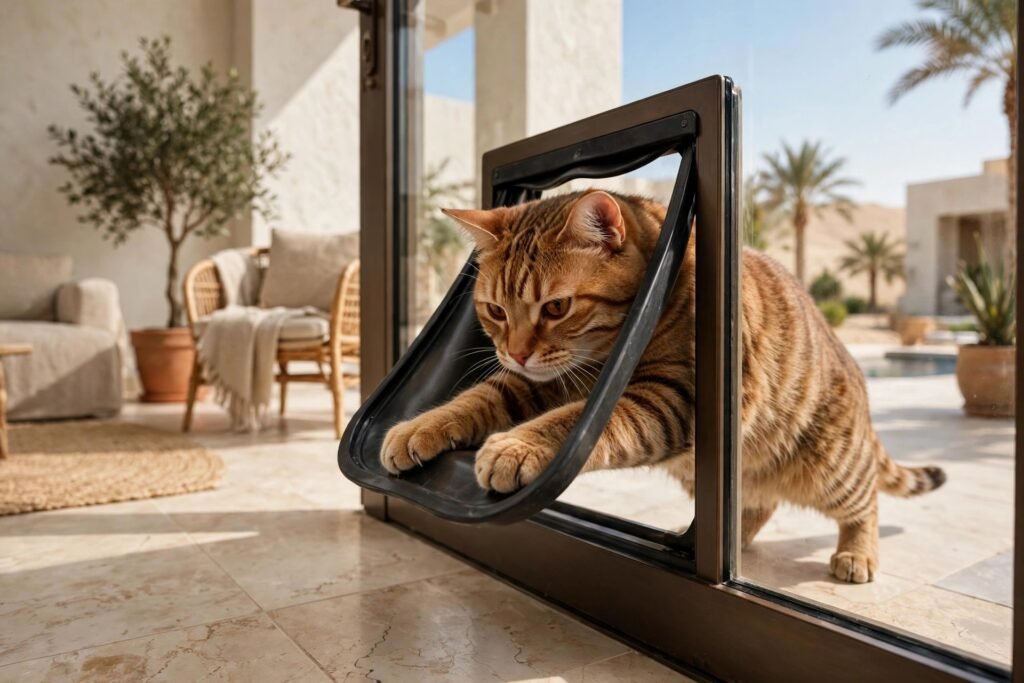
Start with the flap very slightly raised if your pet hesitates, so the first push is almost no push at all, and reward immediately on the other side. Lower it in small stages across the day. Treat luring does the teaching: hold the treat just beyond the flap so your pet’s head nudges it as it reaches, and the moment the flap moves, the treat is delivered and praised. Within a few crossings, most pets connect the nudge with the opening.
If your pet will go one way but not the other — out is common, in is harder — practise the hard direction with the flap partially raised again, and reward more generously for it.
Day three: the full latch, click and all
Now the flap works as it will work from here on: magnetic seal engaged, or microchip lock active and your cat registered to it. Repeat the treat-lured crossings, close together at first, so your pet learns the push needs a little more commitment — and that the small click on a microchip flap is the lock releasing for them, not a warning.
By the end of day three, most pets are using the flap unprompted. Fade the treats over the following days — reward occasionally rather than every time — and leave the pet to discover that the door is now simply how the house works. Dogs are typically quicker than cats, partly because the magnetic resistance on a larger dog flap is trivial against a dog’s weight; small dogs may need the stages stretched a little, exactly as a shy cat would.
Troubleshooting the two usual sticking points
The microchip click
A microchip flap makes a small mechanical click as the lock releases, and some cats startle at it initially. The fix is pairing: let your cat hear the click at a distance during ordinary feeding near the door, reward calm behaviour, and during day-three crossings deliver the treat the instant the click sounds, so the noise starts to predict good things. Proximity at the cat’s own pace is what desensitises — never carry the cat to the flap to get it over with.
Magnet resistance
Magnetic flaps snap shut and stay shut against wind and AC pressure, which means the push is firmer than an unlatched flap. Pets trained through the stages usually adjust within a few crossings once they learn to commit their shoulder or forehead rather than tapping with a paw. If a pet persistently refuses, check the basics first: is the flap the right size — particularly for cats over 4 kg — and is anything obstructing the swing? A correctly sized, freely swinging flap a pet still will not push is worth a call to us, not more treats.
Frequently asked questions
How long does training really take?
The plan is three days for a typical pet: day one with the flap open, day two pushing an unlatched flap, day three on the full magnetic or microchip latch. Shy cats and small dogs may need each stage repeated for an extra day, which is normal and not a setback.
Can I just push my cat through once to show it?
No. Being pushed through teaches the cat that the flap is something imposed on it, and most cats respond by avoiding it. Lured, self-chosen crossings — even slow ones — build the lasting habit.
My cat uses the flap to go out but not to come in. Why?
The push feels different in each direction, and the return trip is often the one that needs work. Practise the return direction with the flap slightly raised again, and reward it more generously, until crossings both ways look equally casual.
The flap clicks and my cat runs off. What now?
Pair the click with food at a comfortable distance first, then during crossings reward the exact moment it sounds. The click is the lock releasing for your cat, and once it predicts a treat, most cats stop reacting to it.
My pet was fine with the old flap but ignores the new one.
A new flap changes the push weight, the sound and sometimes the opening size. Run the three-day plan from day one rather than assuming transfer — most pets convert once the new sensations are familiar.
Talk to us about your flap
If training has stalled, or you are planning a fitting and want the size settled first, WhatsApp us on +971 52 443 2655 with your pet’s breed and approximate weight. You can also email admin@petdoorfix.com. We install across all seven UAE emirates, and honest sizing advice before a fitting saves most training problems before they begin. Patience is the whole secret of how to train a cat to use a cat flap: short sessions, the flap held open first, and the push learned in stages.
Instant WhatsApp Photo Quote
Send a photo of your door, your pet's size, and your area.
WhatsApp Photo QuoteNext guide: Where Should a Cat Flap Go? Choosing the Best Spot in Your Home