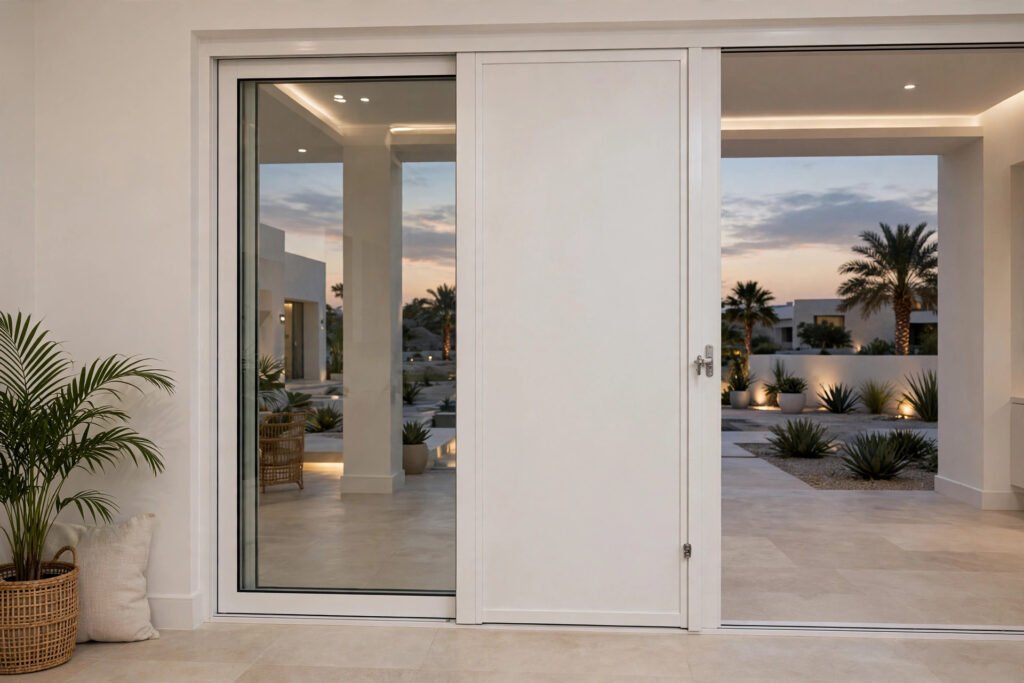
The first security question every villa owner asks about a sliding door pet insert is a fair one: if the insert sits in the track, how do you lock the door? An insert does change how a sliding door closes, but it does not have to leave the door unsecured — this guide explains the locking panels, auxiliary track locks and pet-side controls that keep the door and the flap properly shut. The question behind most security worries is the sliding glass dog door lock: does the door still lock properly with an insert fitted?
See our guide to sliding glass door pet inserts for the full service.
What actually changes when an insert goes in
A pet door insert is a made-to-measure panel that sits in the track of your sliding door, carrying the flap. Your sliding panel no longer closes against the door frame in the original way; it closes against the edge of the insert instead. That is the whole change, and every security measure below follows from it.
It is also why insert quality and fit matter for security, not just for draughts: an insert measured for your track sits firmly in the opening, and the sliding panel meets it along its full height. The measures below then work in layers — closing the flap itself, locking the sliding panel, and controlling which animals can use the flap. Our main guide to secure sliding glass door pet inserts sets out the insert range.
Slide-in locking and closing panels: shutting the flap itself
The most direct answer to “how do I close the pet door?” is the slide-in closing panel. Many dog doors and pet flaps are supplied with a solid panel that slides down or in over the flap opening from inside, covering it completely. Slid into place, it turns the opening into a solid section of door: your pet cannot push out, nothing can push in, and the flap is out of use until you lift the panel away.
Owners use the closing panel in predictable situations:
- At night, when the pets are in and the house is being locked up
- When you travel and the villa is empty or in a house-sitter’s care
- During cleaning or building work, when pets need to stay in one area
- When a pet is recovering, on indoor rest, or too young to go out unsupervised
A manual four-way locking flap gives a lighter version of the same control — set it to fully locked and the flap will not open in either direction. For a complete physical barrier, though, the solid closing panel is the measure to rely on.
Auxiliary patio track locks and pin locks: locking the sliding panel
The second layer locks the sliding door itself. Because the panel now closes against the insert rather than into its original frame position, its original latch may no longer be the lock doing the work — so an auxiliary lock is fitted to do that job directly.
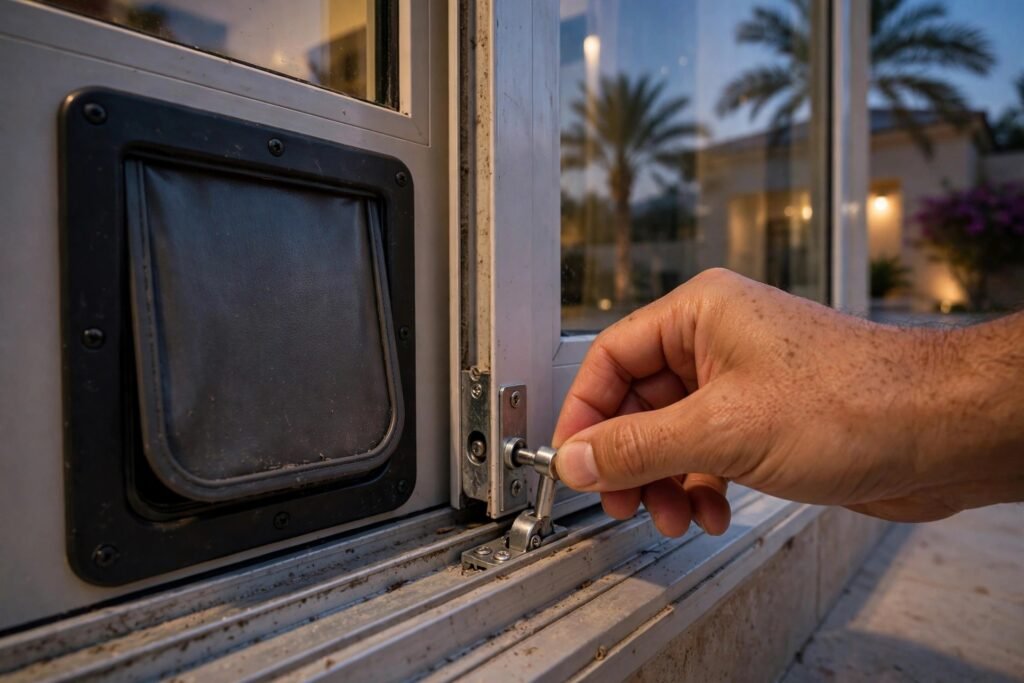
Auxiliary track locks clamp or fix at the track or at the meeting point of the sliding panel, physically preventing the panel from being slid along its track. A door that cannot travel along its track cannot be opened by sliding, which is how a patio door is normally forced.
Pin locks work on the same principle in a simpler form: a pin passes through the sliding panel’s frame into the fixed frame or track, pinning the panel in the closed position, and is withdrawn from inside when you want to use the door yourself.
A security bar seated in the track behind the closed panel is a useful traditional addition, stopping the panel travelling even if it is lifted in its frame. Whichever combination is fitted, the principle is the same — the panel is locked with a lock that acts on the panel itself, not on the latch position the insert has changed, and the arrangement is agreed when the insert is measured, not improvised afterwards.
The pet-side layer: microchip access control
Locking the door keeps people out. It does nothing about the other security problem villa owners raise — stray and neighbourhood cats coming in through the flap itself to eat food, spray and fight with their own cat. That problem is solved at the flap, not the door.
A microchip flap from SureFlap or PetSafe reads your pet’s existing veterinary microchip and unlocks only for your pet. To every other animal the flap is a locked door, day and night, while your own pet passes freely. Fitted in an insert, that gives you selective entry in the panel you can also close and lock at the human scale with the panels and track locks above.
Manual flaps, including Closer Pets models, are supplied for four-way locking only, so they control when the flap can be used, but not which animal uses it while it is open. If stray entry is part of your concern — and in many UAE villa communities it is — microchip is the layer that answers it. For dog inserts, Hakuna Pets and PetSafe doors add strong magnetic sealing, keeping the flap latched against wind between your dog’s trips out.
A simple locking routine for nights and travel
Layers only work if they are used, so most owners settle on a short routine. In the evening: bring the pets in, slide the closing panel over the flap, and set the track lock or pin so the sliding panel is secured for the night. When you travel: closing panel in, track lock set, and the house’s normal locks and alarm routine unchanged — the insert does not ask you to alter anything else about how you secure the villa.
At move-out, the insert simply comes out of the track and the door locks exactly as it did before fitting.
Frequently asked questions
Can a sliding door still be locked with a pet insert in it?
Yes. The sliding panel closes against the insert and is then secured with an auxiliary track lock or pin lock acting on the panel itself, so the door cannot be slid open even though the insert is in the track.
What is a slide-in closing panel, and do I need one?
It is a solid panel that slides over the flap opening from inside, closing the pet door completely. It is the right measure for nights, travel and any time the flap should be fully out of use, rather than simply latched.
Does an insert make my patio door easier to force?
A correctly measured insert sits firmly in the track as part of the closed door arrangement, and the auxiliary locks prevent the sliding panel travelling along its track, which is how sliding doors are opened. The lock arrangement is agreed at measurement, so the fitted result is a secured door.
Can stray cats still get in through the flap in an insert?
Not through a microchip flap. SureFlap and PetSafe microchip models unlock only for your pet’s own chip and stay locked to strays. A manual flap controls timing with its four-way lock, but while set to open it cannot tell one cat from another.
What happens to the locks when the insert is removed?
Nothing permanent has been changed. The insert lifts out of the track and the door returns to its original closing and locking arrangement, which is why inserts suit rented villas as well as owned homes.
Talk to us about a secure insert for your door
WhatsApp us on +971 52 443 2655 with a photo of your sliding door and its track, tell us whether stray cats are part of the problem, and we will advise on the right insert, closing panel and lock arrangement — including same-day fitting on a standard white frame and clear glass insert booked before 10 AM. You can also email admin@petdoorfix.com. We install across all seven UAE emirates. Checked this way, the sliding glass dog door lock works exactly as it did before the insert arrived.
Instant WhatsApp Photo Quote
Send a photo of your door, your pet's size, and your area.
WhatsApp Photo QuoteNext guide: How a Sliding Door Pet Insert Is Measured: Tracks, Height and the Photos We Need First