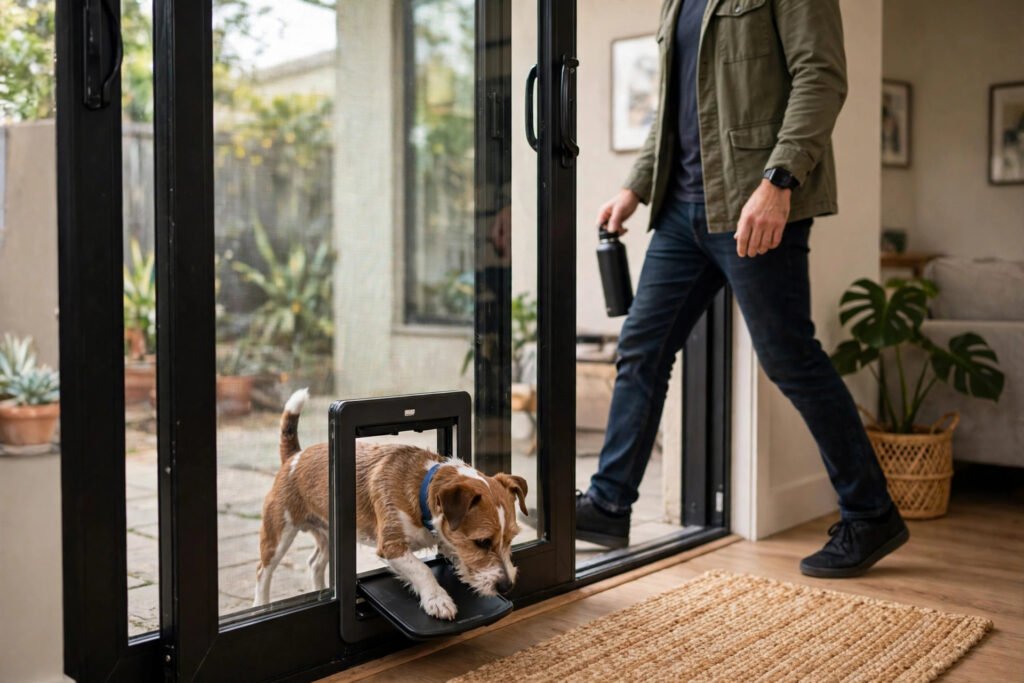
It is the question almost every owner asks before booking, usually while looking at their door and mentally carrying a sofa through it: how much of my doorway do I actually lose? The honest answer is that you lose a section of the opening — the width of the insert panel — and keep the rest. Whether that matters depends on your door’s width and how you use it. This article explains how much doorway a sliding insert takes, what sliding insert walk-through width means in daily life, and how to judge your own doorway before you commit to anything.
Where the width actually goes
A sliding insert stands in the track at one side of the opening. Your sliding door panel slides across and closes against the insert, rather than travelling the full width of the frame and closing against the jamb. So the doorway divides into two parts: the section occupied by the insert, which stays fixed, and the remaining clear opening, which is what you walk through.
The insert section is sized around the flap it carries. A cat flap or a Medium dog flap at 23×35 cm needs a narrower section than an X-Large dog flap at 36×65 cm, because the panel must hold the flap with enough aluminium and glass around it to stay rigid. As a rule, the bigger your pet, the wider the insert section — and therefore the more of the opening it takes. This is the real arithmetic of sliding insert walk-through width: pet size sets the insert width, and the insert width sets what is left.
On a wide villa slider — the kind that spans a living room wall — an insert section is a modest fraction of the whole, and most households stop noticing it within a day. On a narrow single balcony door in an apartment, the same insert takes a proportionally larger bite, and it deserves a proper think before booking.
Sliding insert walk-through width in daily life
Walking through, carrying things through
Daily life is the real test: stepping out with a coffee, bringing shopping in, a child and a dog going through together. What matters is not the doorway’s total width on paper but the clear gap that remains. Think about the widest things that regularly pass through that door — a laundry basket carried sideways, a pram, a deckchair at the start of summer. If those pass comfortably through the space that would remain, the insert will not trouble you.
Furniture and moving day
The occasional wide load — a sofa, a fridge, a mattress — is the one case where a fixed insert section can genuinely be in the way. The saving grace is that an insert is not a permanent fixture. Because nothing is cut or drilled, the insert can be lifted out of the track for a furniture move and put back afterwards, restoring the full opening for as long as you need it. Owners planning a delivery often ask us to time a visit around it, but for a one-off, removing and refitting is a small job in itself.
The other panels still work
On multi-panel doors, only the section where the insert stands is affected. The remaining panels slide as they always did, and the door still closes and locks — against the insert rather than the frame. You are not losing the door; you are narrowing one doorway by one panel section.
Step-over height: the other half of the question
Width is only half of the physical picture. At floor level, two things meet: the track your door already runs in, and the bottom of the flap, which your pet steps over. For the pet, flap height is set so the animal steps through at a comfortable stride — a cat over 4 kg on a Large flap, a big dog on a Large 28×45 cm or X-Large 36×65 cm flap. For the humans, the insert’s lower rail sits within the track area you already step across, so the threshold you are used to does not meaningfully change. If anyone in the household has mobility difficulties, tell us before the fitting — flap position and insert layout can sometimes be arranged to keep the main walking line as clear as possible.
How to judge your own doorway before booking
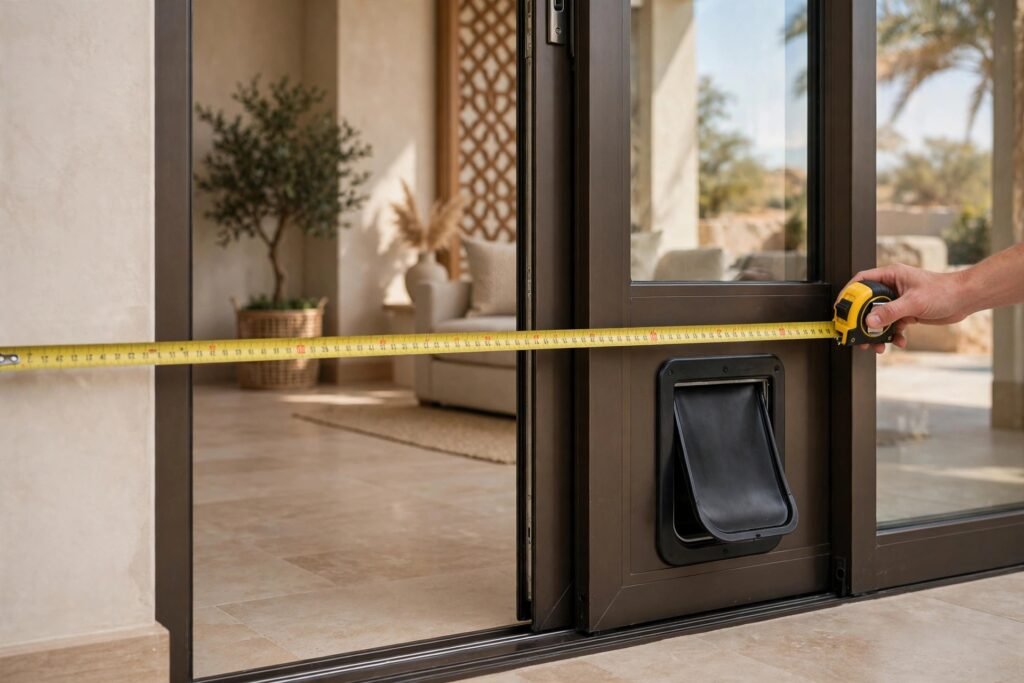
Stand at your door and do three things. First, slide the door open to the position where it would meet the insert — roughly, close off the width of your pet’s flap plus its surrounding panel — and walk through what remains, carrying something awkward. Second, check the biggest regular item that uses the door. Third, consider the alternative honestly: a replacement glass panel keeps the full opening, because the flap sits in a panel that was always part of the door. If the walk-through test feels tight, that is useful information, not a failed test — it simply points you to the other route.
Frequently asked questions
Will I still be able to get a sofa through the door?
In most homes, yes — either through the remaining opening, or by lifting the insert out for the move. Because the insert is not fixed into the building, removing it for a one-off furniture delivery restores the doorway completely, and it refits afterwards.
Does the door still open on the other side?
The sliding panel travels until it meets the insert and closes against it, so the opening is the doorway minus the insert section. On multi-panel systems the other panels are unaffected. Nothing about the door’s runners or locking is changed.
What if my balcony door is very narrow?
Then the walk-through question matters more, and we will say so. For narrow apartment doors, a replacement glass panel is often the better answer because the full opening survives. Send us the door’s width with your photos and we will give you a straight recommendation.
Is the step-over a trip hazard?
The insert sits in the existing track line, which you already step over every time you use the door, and the pet flap’s sill is part of the insert panel, off to one side of your walking line. In normal layouts it does not add a new obstacle in the middle of the doorway.
Can the insert be narrower if my pet is small?
Yes, within limits. The section is built around the flap, so a cat flap insert is slimmer than an X-Large dog door insert. The panel still needs enough structure around the flap to stay rigid and seal properly, which is why we confirm sizes from your pet’s breed and weight before building.
Measure your doorway, then ask us
If sliding insert walk-through width is the thing holding you back, do the walk-through test, then WhatsApp us a photo of your door with its rough width to +971 52 443 2655. We will tell you plainly whether an insert leaves you comfortable space or whether a glass panel suits your door better. Prefer email? Write to admin@petdoorfix.com. We fit inserts across Dubai, Abu Dhabi and all seven UAE emirates.
Instant WhatsApp Photo Quote
Send a photo of your door, your pet's size, and your area.
WhatsApp Photo QuoteNext guide: Sealed Against the Heat: How Sliding Inserts Keep AC In and Dust Out