
If you want a pet door in a sliding glass door, there are two proper ways to do it: a made-to-measure insert that stands in the track, or a newly fabricated glass panel with the flap built in, fitted in place of your existing panel. Both are legitimate, both are reversible, and both appear on our sliding insert or replacement glass panel service page — but they suit different doors and different households. This article sets the two side by side, honestly, so the choice between a sliding insert vs glass panel is made on facts rather than habit.
The two routes at a glance
A sliding insert is an aluminium-framed glass panel, built to the height of your track, that slots into the sliding door track alongside your existing door panel. Your door closes against it, the flap is built into the insert, and your original glass is never touched.
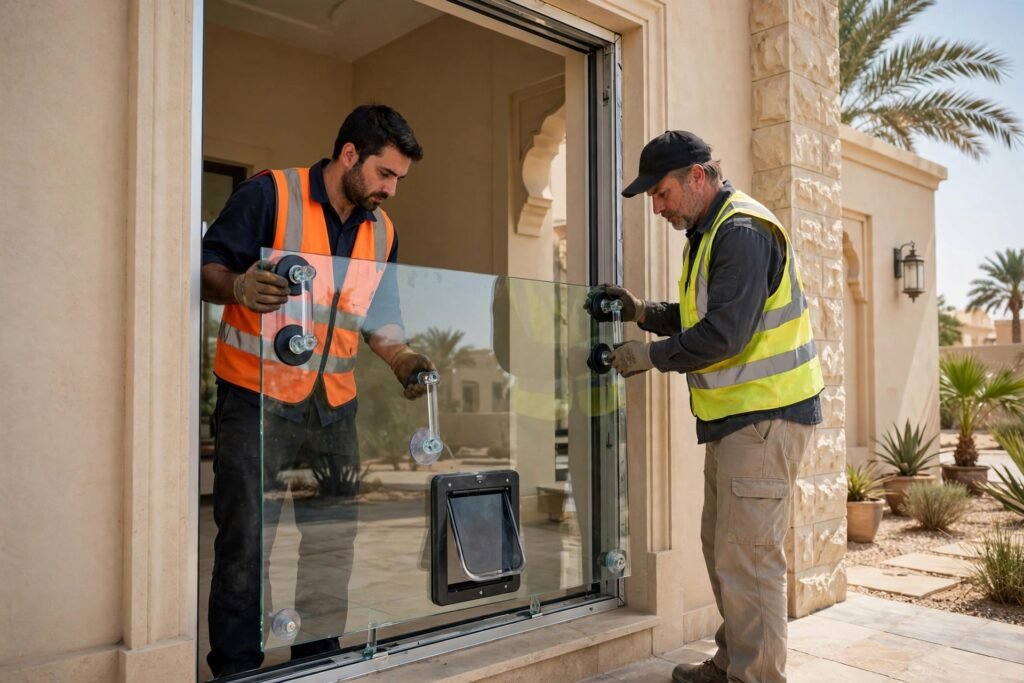
A replacement glass panel is a new panel of tempered glass, fabricated with the flap opening formed during manufacture, which is fitted in place of one of your existing glass panels. The original panel comes out, is kept safely, and can be refitted when you move or sell.
The difference sounds small. In practice it changes the timescale, the effect on your walk-through space, and how the finished door looks and feels.
Sliding insert vs glass panel: the honest differences
How each one is fitted
The insert is fitted into the track as a single unit — nothing is removed, drilled or cut. A standard white aluminium frame with clear glass can be measured and fitted the same day when booked before 10 AM. The replacement panel route is a fabrication job: the new glass is made to order with the flap fitted, then swapped for your existing panel in a single fitting visit once it is ready. If you want the insert frame or the panel’s framework powder-coated in a custom RAL colour to match your doors, that finish adds 2–3 days either way.
What happens to your original door
With an insert, your original door and glass stay exactly where they are; the insert simply shares the track. With a replacement panel, your original glass is carefully removed and stored — by us, safely — and the new panel takes its place. At move-out, the original panel goes back in and the swap-back takes about 30 minutes. Neither route requires a landlord NOC, because neither route cuts or alters the landlord’s property.
Walk-through space and daily use
This is the trade-off owners feel most. An insert occupies part of the doorway: your sliding panel closes against it, so the clear opening you walk through is reduced by the width of the insert. A replacement panel keeps the full sliding opening, because the flap lives in a panel that was always there. If your door is wide, losing a section to an insert is barely noticeable. If your balcony door is narrow to begin with, it can be the deciding factor.
Which doors each route suits
Inserts are made for sliding doors — they need a track to stand in. Replacement panels suit sliding doors too, but they are also the route for fixed glass panels and single openable doors that have no track at all. If the panel you want the flap in does not move, the panel route is usually the answer; if it slides and you want speed and simplicity, the insert usually is.
Who each route tends to suit
Renters on a timeline often choose the insert: nothing is removed, the fitting can be same-day in the standard specification, and at the end of the tenancy the insert lifts out and the door is untouched. Owners in villas they plan to keep often prefer the replacement panel for the cleaner look and the full walk-through width, accepting the fabrication wait. Households with very large dogs need to check flap sizing either way — X-Large flaps at 36×65 cm are available in both routes, alongside Large at 28×45 cm and Medium at 23×35 cm — but a very wide insert section in a narrow doorway tilts the decision toward the panel.
Cats follow the same logic in both routes: any cat over 4 kg needs a Large flap, and the flap itself can be a microchip model from SureFlap or PetSafe, a manual model, or a Closer Pets manual four-way locking flap. The method changes the panel, not the flap choice.
What does not change between them
Whichever route you choose, a few things stay constant. The glass shade caveat: if your doors are reflective or tinted, a replacement panel’s shade cannot be guaranteed 100% identical to the original, and an insert is clear glass — we will always flag this before you commit. The rental position: both routes are 100% rental-friendly with no landlord NOC. And the process: both start with photos of your door on WhatsApp so we can confirm which routes your door genuinely supports.
Frequently asked questions
Can I start with an insert and switch to a panel later?
Yes. Because the insert never alters your door, moving to a fabricated replacement panel later is straightforward — the insert comes out, and the panel swap proceeds as it would have done originally. Nothing about choosing an insert now closes off the other route.
Is one route stronger or more secure than the other?
Both are built from tempered glass and aluminium and both let your sliding door close and lock as designed — with an insert, the door closes and locks against the insert. The practical difference is not strength but layout: opening width, panel position and timescale.
My sliding door is double-glazed. Does that change the choice?
It can. An insert works in the track regardless of the door’s glazing, which is often the simpler answer for double-glazed sliders. A replacement panel for a double-glazed door is fabricated as a new sealed unit instead. Send us photos and we will confirm which route your specific door supports.
Which route is better for a narrow balcony door?
Usually the replacement panel, because it preserves the full opening you walk through. On a wide villa slider, the insert’s footprint is proportionally small and most households never notice it. It is a judgement we will talk through with your door’s measurements in front of us.
Do both routes work if I am renting?
Yes — this is exactly what both were designed around. The insert leaves the door untouched; the panel route stores your original glass and swaps it back in about 30 minutes at move-out. Neither needs a landlord NOC.
Send us the door, we will tell you the route
The sliding insert vs glass panel question is usually settled by one photograph. WhatsApp a picture of your sliding door to +971 52 443 2655 and we will confirm which routes your door supports and the honest pros and cons of each for your home. Prefer email? Write to admin@petdoorfix.com. We install across Dubai, Abu Dhabi and all seven UAE emirates.
Instant WhatsApp Photo Quote
Send a photo of your door, your pet's size, and your area.
WhatsApp Photo QuoteNext guide: How Much Doorway Do You Lose With a Sliding Pet Insert?