
Many UAE homes are double-glazed for sound as much as for heat: the hum of a six-lane road, a flight path, construction that starts before the heat does. So when a pet flap is proposed for that glazing, the sound question follows immediately — have I just put a loudspeaker in my quiet wall of glass? The honest answer is in two parts: most of what your double glazing does for sound survives intact, and the flap is a real but manageable weak point. This article looks at double-glazed pet doors and sound insulation in that order, so you know exactly what double glazed pet door sound insulation you keep, what you give up, and what you can do about the difference.
Why double glazing is quiet in the first place
A sealed double-glazed unit resists sound with three things. Mass: two panes of glass are simply heavier for sound waves to move than one. The cavity: the gap between the panes decouples them, so vibration arriving at the outer pane is poorly transmitted to the inner one. And the seal: the unit’s perimeter is airtight, and sound, like air, exploits any open path. It is worth noticing that two of those three — mass and the airtight perimeter — are about the unit as a whole construction. That matters for what follows.
Double glazed pet door sound insulation: what stays, what changes
What stays: the unit itself
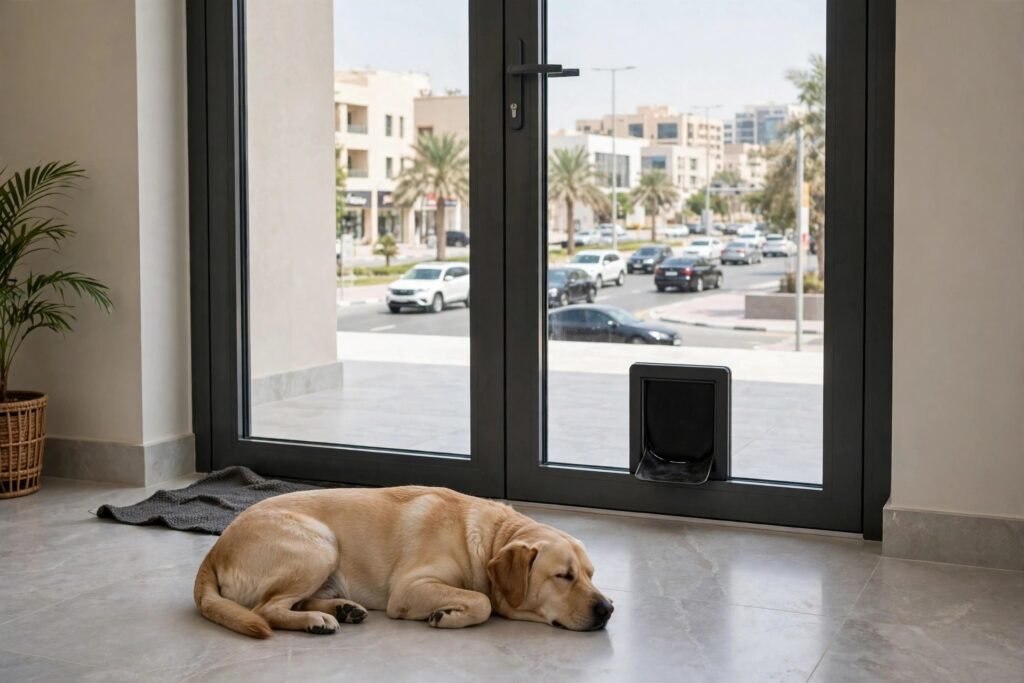
A pet door unit is fabricated as a proper sealed unit — panes cut and tempered with the flap aperture formed beforehand, spacer bar, perimeter seals, dry cavity — by the same process as the unit it replaces. The overwhelming majority of the panel’s area is still two panes, a cavity and a seal. Road hum, aircraft rumble and general outdoor wash are low-frequency, diffuse sounds, and they meet almost the same barrier they met before. Owners are often surprised how little the room’s background quiet changes.
What changes: the flap is the weak point
The flap is a comparatively light, thin panel that exists to move. Sound passes through it more readily than through the glazed unit, and any gap at its edges is a direct path. Two consequences follow. First, higher, sharper sounds — a neighbour’s dog barking, a scooter passing, voices in a corridor — are the ones you may notice more, because the flap is least effective exactly there. Second, the flap’s fit is everything: a flap that closes fully and sits flush, held by its seal, is a far better sound barrier than one hanging a few millimetres ajar. Dog doors from Hakuna Pets and PetSafe close on magnetic seals for this reason among others, and microchip cat flaps from SureFlap and PetSafe latch positively rather than resting loose.
The night-time option: close it properly
Most flaps can be locked or covered with their locking panel. Doing so at night puts a solid barrier back across the weakest point of the panel. For light sleepers with a door near the bedroom, that single habit closes most of the gap between a pet door panel and a plain one.
Practical ways to keep the room quiet
Choose the flap position with sound in mind: in a panel that gives a choice, the flap can sit away from the corner nearest a road or a neighbour’s yard. Keep the flap and its frame clean — grit on a sealing edge holds the flap off its frame, and sound leaks through exactly the gaps that draughts do. Use the locking panel overnight and when the house is empty. And inside the room, the soft finishes that help any room — curtains across the glass at night, rugs, upholstered furniture — do the same work here as they do for a plain door.
Set expectations honestly, though. A panel with a working opening in it will not match the silence of the same panel sealed shut, any more than a window with a vent matches one without. What it can do — and what a well-made, well-fitted unit does — is keep the great majority of the glazing’s sound insulation while giving your pet its independence. For most homes, on most roads, that balance is the one owners actually want.
One more practical note: none of this changes the rental picture. The new unit replaces yours in the same frame, your original glass is stored and swapped back in about 30 minutes when you move, and no landlord NOC is needed. And if your glazing is reflective or tinted, we will discuss shade matching before fabrication — an exact match to the original coating cannot be guaranteed at 100%.
Frequently asked questions
Will I suddenly hear the road inside my living room?
No. The sealed unit still does the heavy work, and broad traffic noise is where it performs best. What you may notice slightly more are sharp, local sounds through the flap itself — a bark, a voice, a gate — and even those are reduced further when the flap is locked at night.
Is a bigger dog flap noticeably worse for sound than a cat flap?
The flap is the weak point, so a larger flap is a larger weak point — an X-Large dog flap at 36×65 cm passes more sound than a cat flap. In practice, correct sizing still rules: a Labrador needs its 36×65 cm opening, and the answer is a well-sealed flap and the night locking routine, not an undersized door.
Does the flap rattle or bang in the wind, adding noise of its own?
A correctly fitted flap closes onto its frame and is held there — by the magnetic seal on dog doors, by positive latching on microchip cat flaps — so wind banging is a sign of wear or poor fit rather than a fact of pet doors. If yours starts to rattle, the seals and edges are the first things to check.
Can the flap go in a different panel to keep the bedroom quiet?
Often, yes. Where a room has more than one suitable panel — a fixed side panel as well as the door, for example — position is a real choice, and we will plan it around how you use the rooms. A flap off the living area rather than the bedroom wall is a common arrangement.
Does draught-proofing and sound-proofing amount to the same work here?
Largely, yes. Sound and draughts use the same paths: the unit’s perimeter, the flap’s closing edges. A unit that is well sealed for air conditioning is well sealed for sound, which is why the fitting standard matters more than any accessory.
Ask us about your noisiest room
If sound is the reason you are hesitating, tell us which room and what you hear through the glass today. WhatsApp photos of the door to +971 52 443 2655 and we will talk honestly about what double glazed pet door sound insulation would mean in that specific room. Prefer email? Write to admin@petdoorfix.com. We install across Dubai, Abu Dhabi and all seven UAE emirates.
Instant WhatsApp Photo Quote
Send a photo of your door, your pet's size, and your area.
WhatsApp Photo QuoteNext guide: How to Tell If Your Glass Door Is Double-Glazed Before You Book a Pet Door