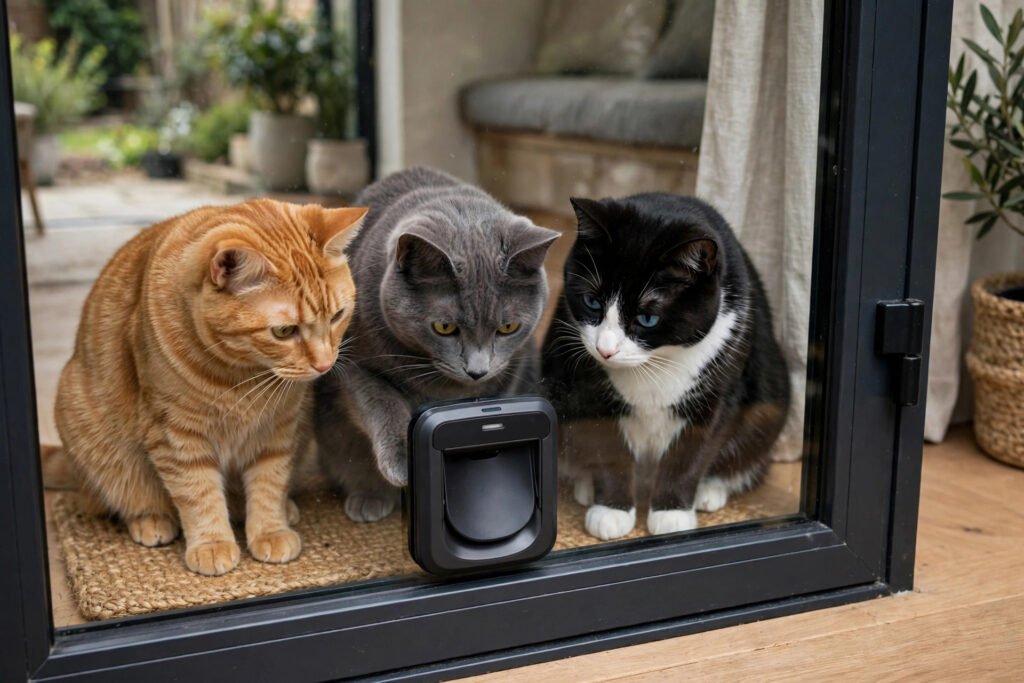
Homes with several cats often assume they need a complicated setup, or that one cat will end up as doorkeeper for the rest. Neither is true. A single microchip flap for multiple cats learns each cat separately, by its own chip, and treats every registered cat as a resident in its own right. Our guide to microchip flaps for multi-cat homes covers the models we fit in glass and sliding doors across the UAE; this article looks at the household side of it — how registration works when there is a whole family of cats to add, and what changes when another cat arrives later.
One flap, one list, every cat recognised individually
A microchip flap does not learn “the cats of this house” as a group. It learns numbers, one at a time. Each cat carries a unique 15-digit ISO FDX-B microchip, the standard chip fitted by vets in the UAE, and during registration the flap stores that number on its internal list. SureFlap and PetSafe microchip flaps both work this way: the cat is the key, and there is no shared key that can be lost or copied.
That individual recognition matters in a busy household. A confident cat that roams the garden and a shy rescue that only uses the flap twice a day are both recognised on their own terms. Neither needs the other nearby, and neither wears anything extra. If your cats already have vet chips, they already carry everything the flap needs.
No chip yet, no problem to solve first
If one cat is not yet chipped — a young kitten, or an older cat who was never done — that cat simply needs a vet visit before registration day. Once the chip is in and your vet has confirmed it reads correctly, that cat joins the list in exactly the same way as the others.
Setting up your microchip flap for multiple cats
Registration day is calm, repetitive work: one clean pass per cat, so the flap stores the right number for the right animal.
Register one cat at a time
Put the flap into learn mode and let the first cat pass through the tunnel, tempted by food on the other side if needed. The reader sits in the tunnel arch, and the chip sits between your cat’s shoulder blades, so a proper walk-through brings the two together. Wait for the flap to confirm the store, test the cat once, and only then bring in the next cat.
Keeping the other cats out of the room during each pass prevents the classic mix-up: a second cat wandering through mid-registration and being stored in place of the cat you meant to add. A closed door and a short list to tick off will save you starting again.
Work through the household in a sensible order
Start with the boldest cat. A confident cat registers quickly, and demonstrates to the others that the strange new doorway is safe. Nervous cats can be left until last, given time to investigate the flap at their own pace, and coaxed through with a favourite meal. There is no prize for finishing in one evening; a cat registered calmly on day two is registered just as securely.
Check size as well as chips
The flap still has to fit the largest animal using it. Cats over 4 kg need a Large flap, and in a mixed household the biggest cat decides the size — two slim cats and one solid British Shorthair should be fitted for the British Shorthair. We confirm breed and approximate weight for every cat before fitting.
When a new cat joins the household later
This is the question multi-cat owners ask most, and the answer is reassuringly dull: you add the new cat in exactly the same way you added the first ones. There is no need to clear the list, re-register the existing cats, or replace the unit. Put the flap back into learn mode, let the newcomer make its own pass, and confirm the store. Your existing cats will not notice; their numbers remain on the list, and the new cat gains the same independent access as everyone else.
New arrivals who are not chipped yet
Rescue cats sometimes arrive with paperwork that is unclear about whether a chip is present and working. Before registration, ask your vet to scan the cat and confirm the chip number and type. If there is no chip, the vet can fit the standard ISO FDX-B chip in the same visit. A kitten can be added in the same way once it has been chipped — there is no pressure to delay the original installation until every future cat is ready.

Living with one shared doorway
Once every cat is registered, daily life settles quickly, each cat using the flap on its own schedule. Two things are worth knowing from the start.
First, a determined second cat can sometimes follow very closely behind a registered cat through the same opening. That is tailgating, not a fault. Households where the distinction really matters — for example, where one cat must stay indoors on veterinary advice — should ask us about models with programmable exit control, which can apply different rules to different chips.
Second, if a cat leaves the household, the stored list can be cleared and rebuilt with fresh passes from the remaining cats. Nothing about the glass or the fitting needs to change.
In glass, the flap sits in a made-to-measure replacement panel; your original glass is stored safely and can be swapped back in 30 minutes, so the installation is 100% rental-friendly with no landlord NOC needed. A reflective-glass shade match cannot be guaranteed 100%.
Frequently asked questions
Can one microchip flap really serve four or five cats?
Yes. Each cat is stored by its own chip number, and every stored cat is recognised independently. Whether the household has two cats or several more, registration is the same one-cat-at-a-time process repeated for each animal.
Do all my cats need to be registered on the same day?
No. Register the cats who are ready, and add others whenever it suits — after a vet visit, once a nervous cat has settled, or when a new cat joins the home. The existing list is not disturbed by adding another cat later.
What if one of my cats does not have a microchip?
That cat needs chipping first. UAE vets fit the 15-digit ISO FDX-B chips these flaps read, and once your vet confirms the chip is scanning properly, the cat can be registered like any other in the household.
Will a big cat and a small cat both manage through one flap?
Yes, provided the flap is sized for the biggest cat. Cats over 4 kg need a Large flap, so we size for the largest animal in the home and the smaller cats use the same generous opening without any difficulty.
Can I remove a cat from the flap’s list?
Yes. The stored list can be cleared and rebuilt by re-registering the cats who remain, one pass each. Owners usually only do this when a cat leaves the household permanently.
Talk to us about registering your whole household
If you are choosing a microchip flap for multiple cats, WhatsApp us on +971 52 443 2655 with a photo of the door and each cat’s breed and approximate weight, and we will confirm the right size and model. You can also email admin@petdoorfix.com. We fit across all seven UAE emirates, including same-day sliding inserts booked before 10 AM.
Instant WhatsApp Photo Quote
Send a photo of your door, your pet's size, and your area.
WhatsApp Photo QuoteNext guide: How Microchip Flaps Keep Stray Cats Out of Your Villa