
It usually starts with the food bowl emptying faster than it should. Then comes the smell of spraying in a spare room, a scuffle at two in the morning, or your own cat sitting tense and watchful in her own kitchen. In villa communities across the UAE, stray and neighbourhood cats learn quickly which homes have an ordinary flap, and an ordinary flap makes no distinction at all. A microchip flap stray cats cannot open changes that completely, and our main guide to keeping stray cats out with a microchip flap explains the models we fit; here we look closely at the stray problem itself, and why chip recognition ends it rather than just discouraging it.
How strays turn your flap into their front door
A stray cat is not being bold. It is following a simple map of its territory: where food appears, where shelter is dry and cool, and which routes are open. An unlocked flap is an open route. Once a cat has eaten in your kitchen twice, your home is marked on that map, and the visits become routine.
Villas are especially exposed. Gardens back onto shared walls and quiet lanes, sliding glass doors open onto patios, and food is often left down for a cat who grazes through the day. Your cat’s own comings and goings lay a scent trail straight to the flap. The stray is, in effect, following your cat home — and through a standard flap, all the way inside.
Why the problem tends to get worse, not better
One visiting cat leaves scent that other cats investigate, so a single intruder can become a small rota of visitors. Unneutered males spray indoors, fights over the food bowl cause injuries, and a nervous resident cat may start hiding or refusing to use its own flap. Owners often respond by locking the flap at night, but that punishes the wrong cat: theirs.
How a microchip flap stray cats cannot open actually works
The principle is a locked door that only your cat can unlock. A microchip flap from SureFlap or PetSafe contains a reader that scans the chip of any cat putting its head into the tunnel. Your cat’s chip — the standard 15-digit ISO FDX-B microchip fitted by UAE vets — is registered to the flap when it is installed. From then on, the flap compares every visitor against that registered list.
If the number matches, the lock releases for long enough for your cat to push through, then closes and locks behind her. If the number does not match, or there is no chip at all, nothing happens. The flap stays locked. A stray pushing with its head meets a solid, unmoving door, tries a few times, and learns what your cat already knows from the other side: this entrance is not for them.
That default-locked state is the important detail. The flap is locked at rest, all day and all night, and opens only in the moment a registered cat uses it. There is no setting to forget and no window of opportunity while you are at work or on holiday.
What about a stray wearing a collar?
It makes no difference. The reader is looking for a registered chip number, not for the presence of any chip or tag. A neighbour’s cat with its own perfectly good microchip is still unregistered on your flap, so it is refused in exactly the same way as a stray with no chip at all. Registration on your flap, and only that, is what opens the door.
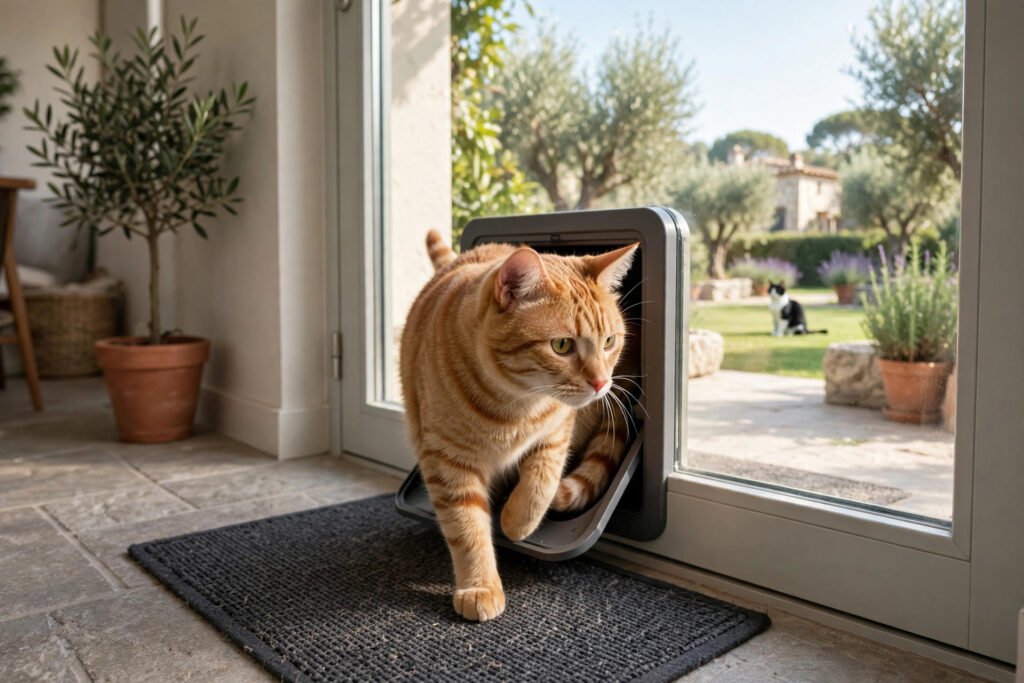
Why half-measures rarely solve a villa stray problem
Owners usually try a few fixes first, and it is worth understanding why they fall short. Locking a manual flap overnight leaves the daytime route open, and locks your cat on whichever side she happened to be. Collar-key flaps depend on a device that can be lost outdoors — usually on the night your cat needs to get in.
Moving the food bowl, or picking food up between meals, is sensible housekeeping, but it removes only one attraction. A cool, quiet villa in the heat of the day is an attraction in itself, and a cat who has claimed your spare room will keep returning while any route in remains open. Selective entry works because it removes the route, for every unregistered animal, without removing freedom for yours.
Fitting position helps the flap do its job
In a glass door, the flap sits in a made-to-measure replacement panel, positioned at your cat’s height so the reader meets the chip between her shoulder blades on every pass. Cats over 4 kg need a Large flap. We set height and size from your cat at the survey stage, before anything is made.
Keeping your home yours, in rented and owned villas alike
Most villa tenants assume a proper solution has to wait until they own somewhere, but a glass fitting is fully reversible. Your original glass is stored safely and swapped back in 30 minutes when you move out, making the installation 100% rental-friendly with no landlord NOC needed. With tinted or reflective glass, a shade match cannot be guaranteed 100%.
For sliding doors, the flap can sit in a track insert instead — bookable as a same-day sliding insert if you book before 10 AM, with the standard white aluminium frame and clear glass, while custom RAL powder-coating takes 2–3 days. Either way, the stray problem is solved at the one point it actually happens: the doorway itself. The stray tests the flap, fails, and moves on; your cat keeps the run of the garden, and the food bowl empties at the speed of one cat again.
Frequently asked questions
Can a determined stray force a microchip flap open?
A microchip flap is locked at rest and only unlocks when a registered chip is read in the tunnel. A stray pushing against it meets a locked door, not a loose flap, so pushing achieves nothing and most strays stop trying after a few attempts.
Will the flap also keep out my neighbour’s cat?
Yes. Only cats registered on your flap are recognised, whatever chips other cats carry. A neighbour’s cat, a stray with no chip and any other unregistered animal are all treated the same way: the lock stays shut.
My cat is not microchipped. Can I still solve this?
Your cat needs a chip first, which any UAE vet can fit — the standard 15-digit ISO FDX-B chip. Once your vet confirms it scans correctly, we register it to the flap and your cat becomes the only animal the flap will admit.
What if a stray follows my cat in very closely behind her?
A cat can occasionally tailgate through in the same moment as a registered cat’s pass. It is uncommon, and very different from a stray letting itself in at will through the day and night, but tell us if it happens and we will talk through positioning and settings.
Does the solution work in a rented villa?
Yes. The original glass is stored and swapped back in 30 minutes at move-out, so the fitting is 100% rental-friendly and needs no landlord NOC. The door is returned to its original condition.
Talk to us about locking strays out for good
If a microchip flap stray cats cannot open sounds like the end of your villa’s visitor problem, WhatsApp us on +971 52 443 2655 with a photo of the door or glass panel and your cat’s breed and approximate weight, and we will confirm the right model and size. You can also email admin@petdoorfix.com. We fit across all seven UAE emirates, in owned and rented homes alike.
Instant WhatsApp Photo Quote
Send a photo of your door, your pet's size, and your area.
WhatsApp Photo QuoteNext guide: Batteries, Beeps and Low Power: How Microchip Flaps Behave as Power Runs Down