
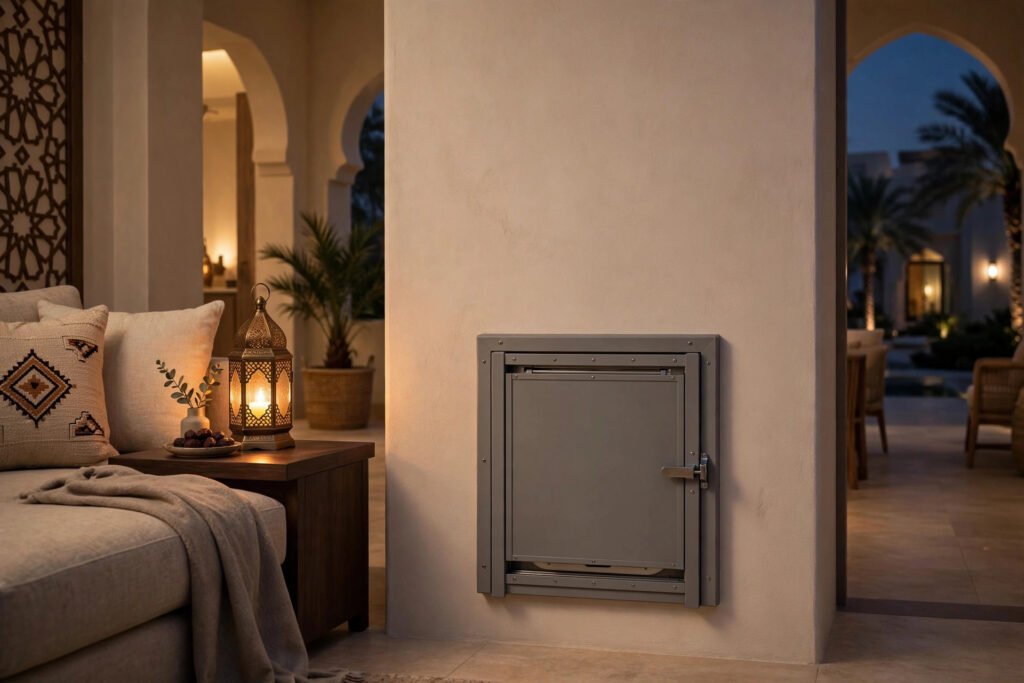
A pet door is a hole in the house that only your pet is meant to use. Most of the time the flap itself — closed on its magnets, or locked to your pet’s chip — is security enough. But there are hours when “the flap is shut” is not the same as “the opening is closed”: overnight, while the house stands empty on holiday, or when a tradesperson is coming and going. That is what a pet door security locking panel is for. Security panels for wall and wooden pet doors turn the pet’s doorway back into solid door or wall at the slide of a rigid panel.
Why a flap needs a lock-down option
Think about what a flap is from the street: an opening, at ground level, sized for an animal. Cat-sized openings admit only animals. But dog doors run to X-Large at 36×65 cm, and it is honest to say plainly that a large unsecured opening is a real gap in the house’s defences — at minimum an invitation to every stray in the neighbourhood, and a reach-through risk to interior door handles if the flap is positioned carelessly. A locking panel removes the question entirely: with the panel on, there is no opening, for anything, until you take it off.
How a pet door security locking panel works
The panel is a rigid board or plate, sized to the flap unit, that mounts over the interior face of the pet door. Most slide down into channels on the frame or clip and fasten in place; all share the same principle — they are fitted from inside the house, cover the whole opening, and cannot be pushed out from outside because the flap’s tunnel or the door itself is between the panel and the street. Installation is part of fitting the flap: the channels or fixings go on with the unit, and from then on the panel drops in or lifts off in seconds.
A panel is deliberately simple. There is nothing to charge, pair or go wrong — which is rather the point of a security device you rely on while you are away.
Panels, locking flaps and microchip flaps: three different jobs
These are often confused, so it is worth separating them. A locking flap — the four-way lock on manual models such as Closer Pets and PetSafe flaps — controls the flap’s own movement: in only, out only, both or neither. That is traffic control for your pet, not a barrier; a determined push tests a locked flap more than we would like. A microchip flap from SureFlap or PetSafe is selective: it stays locked to every animal except yours, which solves strays beautifully but is still a flap, doing a flap’s job. A locking panel is the only one of the three that physically closes the opening. Sensible setups layer them: microchip or locking flap for daily control, panel for nights away and empty houses.
Choosing and fitting the panel
The panel must match the unit it covers — sized to the frame, rigid enough not to flex under pressure, and mounted on the room side. On wall tunnels it fits at the inner end of the tunnel; on wooden doors it covers the flap from inside the house. It cannot be an afterthought bodged over the hole: a panel that rocks in loose fixings is decoration. Fitted with the door, with proper channels or fixings, it becomes part of the unit, and it doubles as a blanking plate for the weeks a pet is in kennels, at the vet, or simply too young to go out.
A sensible routine
Panel on before bed if the door is in a quiet, unobserved part of the house. Panel on whenever the house is empty for more than the day. Panel on during storms, when wind can worry a flap. And the rest of the time, panel off and the pet’s door back in service. None of this replaces the ordinary stuff — locking human doors, closing windows — it simply returns the pet opening to the same standard as the rest of the house.
Frequently asked questions
Can someone reach through a large pet door?
An X-Large flap at 36×65 cm is a substantial opening, and we will not pretend otherwise. Position matters — never where a reach could find an interior handle — and a fitted locking panel closes the opening completely at night and when the house is empty, which is the correct answer to the risk.
Does the locking panel fit any flap?
Panels are sized to the unit they cover and need their channels or fixings in place, so they are best fitted with the door itself. Tell us the model and we will match the panel to it, whether the flap sits in a wooden door or a wall tunnel.
Can the panel be forced from outside?
It mounts on the interior face and covers the opening, with the tunnel or door leaf between it and the street, so it cannot simply be pushed in like a flap. Like any fitting it is part of a sensible whole-house routine, not a substitute for one.
Is a locking panel enough on its own, without a microchip flap?
They do different jobs. The panel secures the opening when the pet is not using it; it does nothing to control which animal uses the flap the rest of the day. If strays are your problem, that is the microchip flap’s job — the two together cover both.
Where does the panel live when it is off?
Most owners keep it beside the door it belongs to — in the utility room or the cupboard under the stairs. It is flat and light. The one rule is to put it back in the same place every time, so the night you need it is not the night you hunt for it.
Close the door properly, every night
If your wall or wooden pet door has no panel — or you are planning the door and security is the thing holding you back — a pet door security locking panel fitted with the unit closes the question. Send us a photo of your door or wall on WhatsApp at +971 52 443 2655 and we will spec the flap and panel together, or email admin@petdoorfix.com. We install across all seven UAE emirates.
Instant WhatsApp Photo Quote
Send a photo of your door, your pet's size, and your area.
WhatsApp Photo QuoteNext guide: Making Good a Wooden Door After a Pet Flap Comes Out