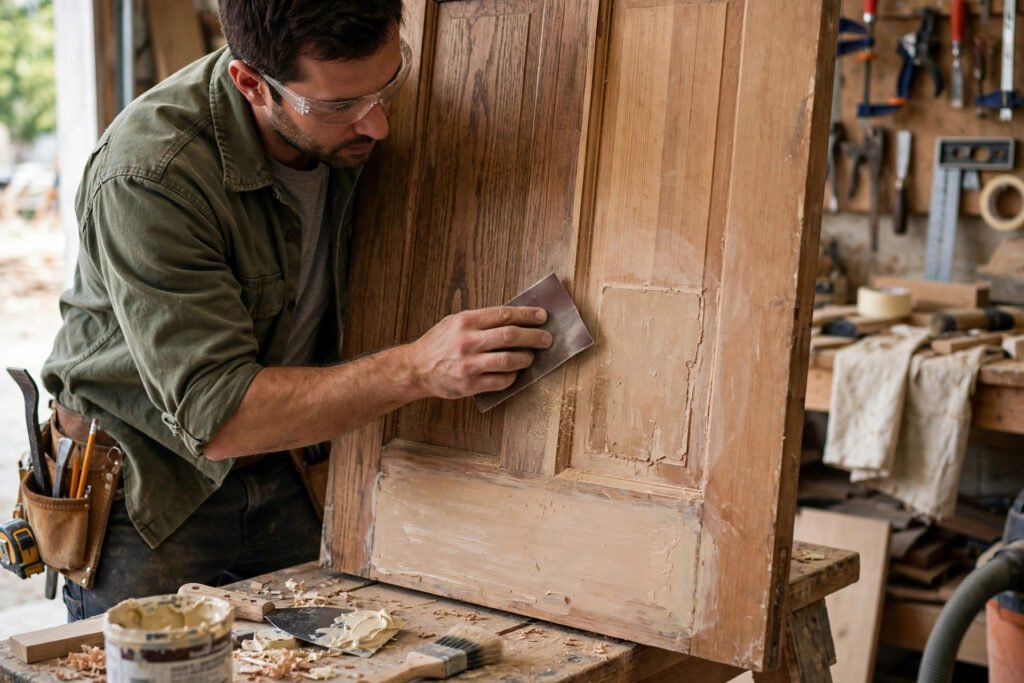
Everything comes out eventually: the pet dies, the family moves, the door is redecorated. With our glass work, removal day is the easy part of the story — the original panel comes out of storage and is swapped back in 30 minutes, leaving no trace. A wooden door tells a different story: removing a cat flap from a wooden door is where the work starts, and this guide tells it straight. The door was cut to fit the flap; the flap comes out in minutes; the hole stays. Making good a door after flap removal is a carpentry question with three real answers, and the right one depends on the door, its finish and how invisible you need the repair to be.
Why a wooden door can’t simply be un-fitted
A flap in a wooden door is not attached to the door — it is through it. The leaf was cut to the flap’s outline, the unit sat in that opening, and the screws only held it in place. Remove the unit and the opening is still there, flap-shaped, usually with screw holes around it. No filler from a tube closes a hole that size on its own, and the door’s structure around the opening was doing less work the whole time the flap was fitted. None of this is a disaster. It is simply why wooden-door flaps are an owner’s decision, made knowing the door carries the alteration until someone makes it good.
Removing a cat flap from a wooden door: your three options
Fill and patch. The opening is backed and filled in stages, then sanded flush and finished to match. On a solid painted door this can come up very well — the repair takes paint like the rest of the door and, once painted over, is hard to spot. Its limits are real: filler patches large enough to fill a flap hole can shrink or crack at the edges if rushed, and on a hollow-core door the patch has little to bond to and stays the weak point of the leaf.
Re-panel the opening. A carpenter cuts the opening back to clean edges and fits a proper timber section or panel into it, glued and pinned, then finishes it flush. This restores real substance to the door rather than relying on filler, and it is the right answer for a solid door you intend to keep — the closest thing to the hole never having been there, on a door with a painted finish.
Replace the leaf. Sometimes the honest answer is a new door: where the old one was hollow, damaged, due for replacement anyway, or one of a matching pair where a repair would show against its twin. It is the biggest job and the only one that returns the doorway to genuinely unaltered.
In short, the steps are:
- Remove the unit – the opening stays, flap-shaped, usually with screw holes around it.
- Pick the repair for your door: fill and patch, re-panel the opening, or replace the leaf.
- Fill and patch: back the opening, fill in stages, sand flush, and finish to match.
- Re-panel: cut the opening back to clean edges and fit a proper timber section or panel.
- Replace the leaf where the old one was hollow, damaged, or due for replacement.
- Finish to match – on a painted door, filler and patches disappear under paint.
What the repair looks like when it’s done
Finish decides visibility. A painted door is forgiving — filler and patches disappear under paint, and a fully repainted leaf shows nothing at all. Varnished and stained doors are not forgiving: grain and colour rarely match across a patch, and in angled light a repair on a clear-finished door will usually show as a change in the figure of the wood, however well it is made. If your door is varnished hardwood and invisibility is the standard, plan on re-panelling plus refinishing the whole leaf, or replacing it — and factor that into the decision before the flap ever goes in.

When making good isn’t needed at all
Before booking a carpenter, consider the alternatives. A incoming owner with pets may be delighted the flap is there — ask before repairing it away. If the flap is staying but unused, a rigid locking panel blanks it off securely with no carpentry at all. And if the flap model is being upgraded, a new unit of the same size range can occupy the existing opening, screw holes and all: the hole only needs making good when the door is going back to being just a door.
Frequently asked questions
Can the repair be completely invisible?
On a painted solid door, effectively yes — a re-panelled or well-filled section under a full repaint is not findable in normal light. On varnished or stained timber, expect the repair to show faintly in the grain, however careful the work. We would rather tell you that now than after the door is cut.
Is filling a hollow-core door strong enough?
A filled patch in a hollow door is a surface repair on a door with little material to bond to; it can look acceptable but remains the weakest part of the leaf and can crack if the door is slammed hard. For a door you rely on, re-panelling the section or replacing the leaf is the sounder fix.
Can I just screw a board over the hole?
You can, and people do, as a stop-gap. It looks like what it is, it draughts around its edges, and it does nothing for the door’s strength. As a temporary security measure while a proper repair is arranged, fine; as the finished answer, no.
Will a new flap fit the old hole?
Often, yes, if the replacement is the same size range — dog doors run Medium 23×35 cm, Large 28×45 cm and X-Large 36×65 cm, and cat flaps cluster around standard sizes, with cats over 4 kg in a Large. Measure the existing cut-out before ordering, or send us a photo and the measurements and we will confirm the fit.
I rent — can I have a flap removed from a door my landlord approved?
If a landlord approved a flap in their door, the door still has to be made good at the end of the tenancy, and the cost and quality argument at handover is exactly why we steer tenants to glass: an original panel stored and swapped back in 30 minutes, no NOC, no carpenter, no deposit discussion.
Decide before the cut, not after
If you own the door and have weighed it, fit the flap happily — wooden doors serve pets for years, and removing a cat flap from a wooden door one day is a known, manageable carpentry job, not a crisis. If any part of this page made you wince, that is the signal to choose the reversible glass route instead. Talk it over with us on WhatsApp at +971 52 443 2655 — send a photo of the door and tell us whether you own or rent, and we will advise honestly, including if the answer is to leave the door alone — or email admin@petdoorfix.com.
Instant WhatsApp Photo Quote
Send a photo of your door, your pet's size, and your area.
WhatsApp Photo QuoteNext guide: Can You Put a Dog Door or Cat Flap in a Sliding Fly-Screen Door? (UAE Villa Guide)