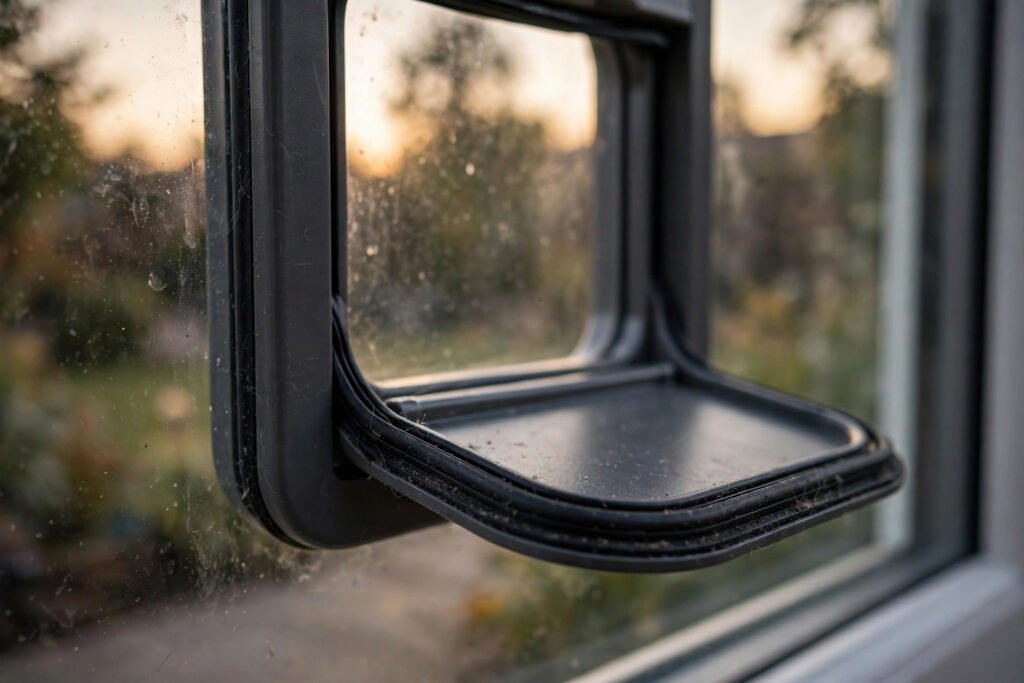
It starts as a tap. Then, on a breezy evening, it becomes a steady clatter — tap, tap, bang — while the room slowly feels warmer. The noisy cat flap magnetic seal problem is rarely about the cat. It is usually about a flap that no longer sits closed: a worn seal, a warped frame, or a flap fitted loosely in its panel, free to swing whenever the pressure changes. This guide to stopping a cat flap banging in the wind explains why flaps rattle, what a magnetic seal does, and how a correct fit keeps a flap shut, quiet and weather-tight.
Why a loose flap rattles in the first place
A cat flap is a hinged door within a door. For your cat to use it easily, the flap has to swing freely — and anything that swings freely will also move when the wind asks it to. The seal and the fit are what stop that freedom becoming noise.
Pressure, gusts and the shamal
Shamal winds can push dust-laden air against villa and apartment doors for hours, and even a modest breeze creates a pressure difference between inside and outside. If your flap does not close firmly against its frame, each gust lifts it slightly and drops it back. That repeated lift and drop is the banging you hear, and it is worse on exposed sliding doors and garden-facing glass.
Worn seals and tired flaps
Seals age. Brush strips flatten, flexible edging hardens in the heat, and a flap that once sat flush can develop a gap on one side. Once there is a gap, air moves through it, the flap moves with the air, and the noise begins. A frame sitting fractionally out of square can do the same, leaving one corner free to chatter while the rest looks fine.
Solving the noisy cat flap magnetic seal problem
A magnetic seal solves the closing half of the problem. Instead of relying on gravity alone to bring the flap back to rest, magnets set into the flap and frame draw the two together as the flap swings home.
How the magnetic closure works
As your cat passes through, the flap swings open normally — the magnets are not a lock, and they do not make the door heavy to push. As the flap returns, the attraction takes over for the last part of the swing and pulls it into its seated position, then holds it there against light wind pressure. A flap that is held shut cannot build up the swing that makes a bang.
Magnetic closure only works well when the rest of the fitting is right. If the frame is out of square, or the flap is the wrong size, one section of seal may meet its magnet while another stands proud. That is why we treat noise as a fit problem first: check alignment, check size, then check the seal.
Brush seals help too
Around the magnetic edge, brush or flexible draught seals close the remaining hairline gaps and soften the final contact, so a gust meets a cushioned edge rather than hard plastic on hard plastic. Together, these give you a flap that closes with a soft click rather than a clatter.

Wind, dust and cooled air: the UAE cost of a gap
Noise is the symptom you notice first, but in a UAE home it is rarely the only cost of a flap that will not stay shut.
Cooled air leaks out
Every time a loose flap lifts, cooled indoor air escapes and hot outdoor air enters. One opening is small, but a flap lifting dozens of times an hour through a windy night is a steady leak in a room you are paying to cool. A flap held shut by its seal keeps the boundary of the room intact between your cat’s trips.
Dust rides the same gap
Shamal conditions carry fine dust that finds every opening. A gap around a flap is an invitation: dust settles inside the door, works into the mechanism, and accelerates the wear that made the gap worse. Wiping the seal edge clean during routine cleaning also helps the magnets meet properly, because a layer of grit can hold the flap fractionally off its seat.
Choosing and fitting a quieter flap in glass
If your current flap is worn, warped or simply the wrong size, adjustment may not be enough, and replacement is the cleaner answer. Look for a positive magnetic closure, a rigid frame that will stay square, and seals that can be kept clean. For cats over 4kg, choose a Large flap: a cat squeezing through a too-small flap pushes at an angle, which wears one side of the seal faster and brings the rattling back sooner.
In glass, the flap sits in a made-to-measure panel, so panel and frame are made for each other and the seal line is even all the way round. The fitting stays 100% rental-friendly: your original glass is stored safely and swapped back in 30 minutes when you move out, with no landlord NOC needed. On reflective glass, a reflective-glass shade match cannot be guaranteed 100%, so we discuss the finish before the panel is made.
For dog doors, Hakuna Pets makes dog doors with magnetic seals. For cat flaps, SureFlap and PetSafe make manual models as well as microchip models, so you can solve the noise while deciding whether you also want selective entry.
Frequently asked questions
Why does my cat flap only bang at night?
Wind often changes direction in the evening, and a quieter house makes the same noise far more noticeable. The flap is probably lifting in gusts that were there during the day too — you simply could not hear it over normal household sound.
Will a magnetic seal make the flap too stiff for my cat?
No. The magnets act over the last part of the closing swing and hold the flap against light wind; they are not a lock. Your cat still pushes through normally. If a cat is struggling, the cause is usually flap size or fitting height rather than the seal.
Can I just replace the seal on my old flap?
Sometimes, if the frame is still square and the flap undamaged. If the flap is warped, the frame misaligned, or the flap the wrong size for the opening, a new seal will meet unevenly and the noise will return. In glass, a replacement usually means a fresh made-to-measure panel so everything lines up.
Does a banging flap mean cooled air is escaping?
Very likely, yes. A flap that lifts in the wind is a gap in the door each time it moves. A flap held shut by its magnetic seal between uses keeps cooled air in and hot, dusty air out far more effectively.
What if my cat is large and pushes the flap hard?
Fit a Large flap if your cat is over 4kg. A cat that fits comfortably pushes straight through the centre, keeping wear even around the seal. A cat squeezing through a small flap twists it sideways, and that uneven wear is a common cause of rattling.
Talk to us about a quieter flap
WhatsApp us on +971 52 443 2655 with a short video of the flap moving, or a photo of the door, and tell us when the noise happens. If the noisy cat flap magnetic seal on your current fitting has worn out, we will say honestly whether a replacement flap in a fresh panel is the better fix. You can also email admin@petdoorfix.com. We fit cat flaps across all seven UAE emirates.
Instant WhatsApp Photo Quote
Send a photo of your door, your pet's size, and your area.
WhatsApp Photo QuoteNext guide: Four-Way Locking Explained: In Only, Out Only, Both or Neither