
A cat flap can be the right model, the right size and fitted in the right door — and still be wrong, if it sits at the wrong height. Set it too high and your cat must rear up and scramble through; set it too low and the cat must duck and crouch, catching its back on the frame. Getting the cat flap fitting height right comes down to one simple rule based on your cat’s belly, and our full guide to the right height for a cat flap sits alongside the fitting options for glass and sliding doors. This article explains the measurement and why it matters.
The belly-height rule for cat flap fitting height
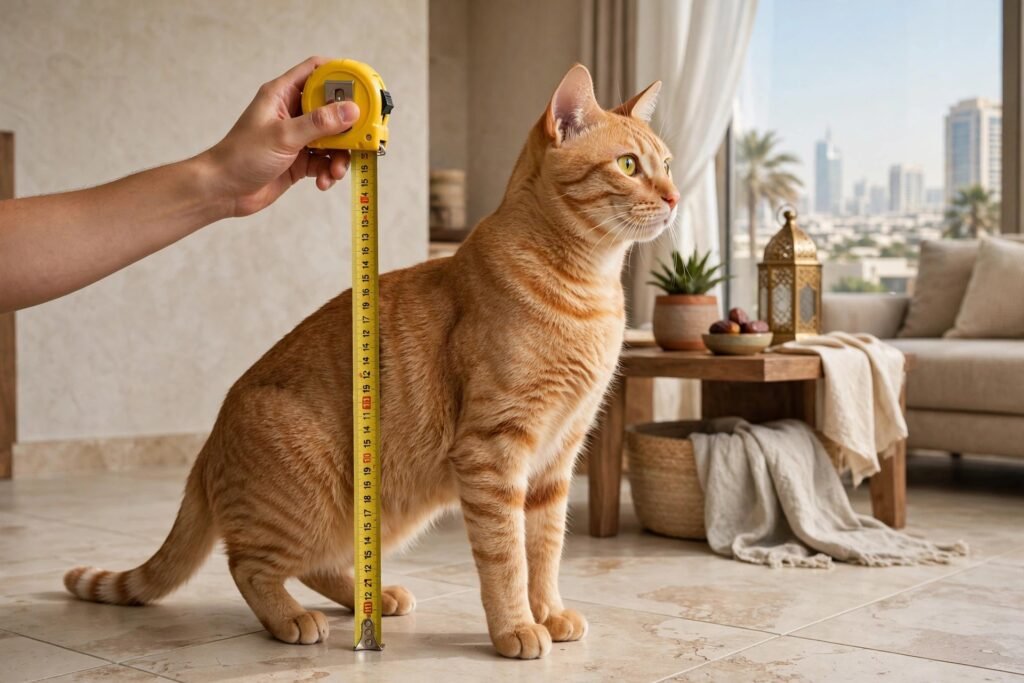
The rule is straightforward: the bottom of the flap opening should sit roughly level with your cat’s belly, so the cat can walk through on a level line, stepping over a low lip rather than jumping or stooping.
How to measure your cat
Wait until your cat is standing calmly on a level floor, then measure from the floor up to the lowest point of the stomach. For most adult cats that distance is a modest handful of centimetres — legs are shorter than owners tend to picture once a cat is standing naturally rather than stretching. That measurement is the guide for where the bottom edge of the opening belongs.
Centre the flap on a level walk-through
With the belly measurement as the starting point, the flap is centred so the cat’s body passes through the middle of the opening with clearance above its back and below its chest. The cat should be able to keep its head at a natural height, push the flap with its face or shoulder, and walk — not climb — through.
Allow for the frame, not just the opening
The measurement that matters is the opening the cat passes through, not the overall size of the unit. Frames and tunnels take space around that opening, so we work from the opening itself when we mark up a panel.
Why height matters more than owners expect
A flap that asks for an awkward movement is a flap that gets avoided.
A flap set too high
A high flap forces the cat to stand on its hind legs, hook its front paws over the lip and haul itself through. Agile young cats may manage it; many simply refuse, and an older cat or a cat with stiff joints may be physically unable to. A high fitting is one of the most common reasons a newly fitted flap goes unused.
A flap set too low
A low flap is just as off-putting in the other direction. The cat must crouch, drop its shoulders and wriggle, with the top of the opening pressing along its back. Heavier cats, whose bellies sit lower and whose frames are broader, feel this most — and cats over 4kg need a Large flap as well as a correctly set height, so that size and position work together rather than against each other.
Microchip readers and height
With a microchip flap, height has a second job. The reader must meet the chip, which sits between the cat’s shoulder blades, as the cat reaches the flap. A flap centred on the cat’s body puts the reader in the right place naturally. These flaps read the pet’s existing 15-digit ISO FDX-B vet chip, and correct height is part of what makes that read quick and reliable.
Height for older, heavier and less mobile cats
Comfort at the flap matters most for the cats who have the least spare agility to give.
Older cats and stiff joints
A senior cat should barely have to step at all. Setting the bottom of the opening at or fractionally below belly height gives a low, level step-over that arthritic joints can manage, and pairing that with a flap that swings freely — rather than one the cat must push hard against — keeps the route usable for years.
Heavier and larger breeds
British Shorthairs, Ragdolls and Maine Coons carry more body lower down, and their belly measurement reflects that. Measure the actual cat in front of you rather than working from a breed average, and combine the right height with the Large flap that cats over 4kg need. SureFlap and PetSafe microchip and manual models can all be set at the measured height during fitting. So can the manual four-way locking flaps from Closer Pets. Height is a fitting decision, not a model limitation.
Kittens who will grow
A flap fitted for a kitten’s belly today will be too low within months. Where a young cat will use the flap as an adult, we set the height for the adult cat and supervise its early use.
Height when the flap is fitted in glass
In glass, the height is decided before anything is made. The flap sits in a made-to-measure replacement panel, so its position is marked from your cat’s measurement at the survey stage and built into the panel. Your original glass is stored and can be swapped back in 30 minutes, keeping the fitting 100% rental-friendly with no landlord NOC needed.
For sliding doors, a flap in a track insert follows the same belly rule in relation to the floor level inside. If you book before 10 AM, an insert in the standard white aluminium frame with clear glass can be fitted the same day, with custom RAL powder-coating taking 2–3 days. One note for reflective glass: a shade match on a replacement panel cannot be guaranteed 100%. We fit across all seven UAE emirates, and in every case the measurement starts with your cat, standing on your floor.
| Cat | Fitting height |
| Standard adult cat | Bottom of the opening roughly level with the belly – measure from the floor to the lowest point of the stomach |
| Large cat (over 4 kg) | Large flap; bottom of the opening at belly height, measured on the actual cat – heavier cats’ bellies sit lower |
| Senior or stiff cat | Bottom of the opening at or fractionally below belly height, for a low, level step-over |
| Kitten | Set the height for the adult cat where the kitten will use the flap as an adult – a kitten-height flap will be too low within months |
Frequently asked questions
How do I measure my cat for flap height?
Stand your cat on a level floor and measure from the floor to the lowest point of its stomach. That belly height is the guide for the bottom edge of the flap opening. We confirm the measurement before any panel is made.
What happens if a flap is fitted too high?
The cat has to rear up and pull itself through, which many cats refuse to do and older or stiffer cats may be unable to do. It is one of the most common causes of an unused flap, and it is avoided by measuring first.
Does a heavier cat need a different height or just a bigger flap?
Usually both considerations together. Cats over 4kg need a Large flap, and because a heavier cat’s belly sits lower, its height should be set from its own measurement rather than a standard position.
Can the height be adjusted after fitting in glass?
The flap’s position is built into the made-to-measure panel, so it is not a simple adjustment afterwards. That is exactly why the measurement is taken and confirmed before the panel is produced.
Is the belly rule the same for microchip and manual flaps?
Yes. The walk-through comfort rule is identical. A microchip flap has the added benefit that correct height also places the chip reader in line with the chip between the cat’s shoulder blades.
Talk to us about getting the height right
Getting the cat flap fitting height right the first time is simply a matter of measuring before anything is made. WhatsApp us on +971 52 443 2655 with a photo of the door or panel, your cat’s breed and approximate weight, and its floor-to-belly measurement if you have it, and we will confirm the flap size and position. You can also email admin@petdoorfix.com. We fit across all seven UAE emirates, with original glass stored and ready to swap back in 30 minutes whenever you move.
Instant WhatsApp Photo Quote
Send a photo of your door, your pet's size, and your area.
WhatsApp Photo QuoteNext guide: A Kitten’s First Cat Flap: When Young Cats Can Start Using One