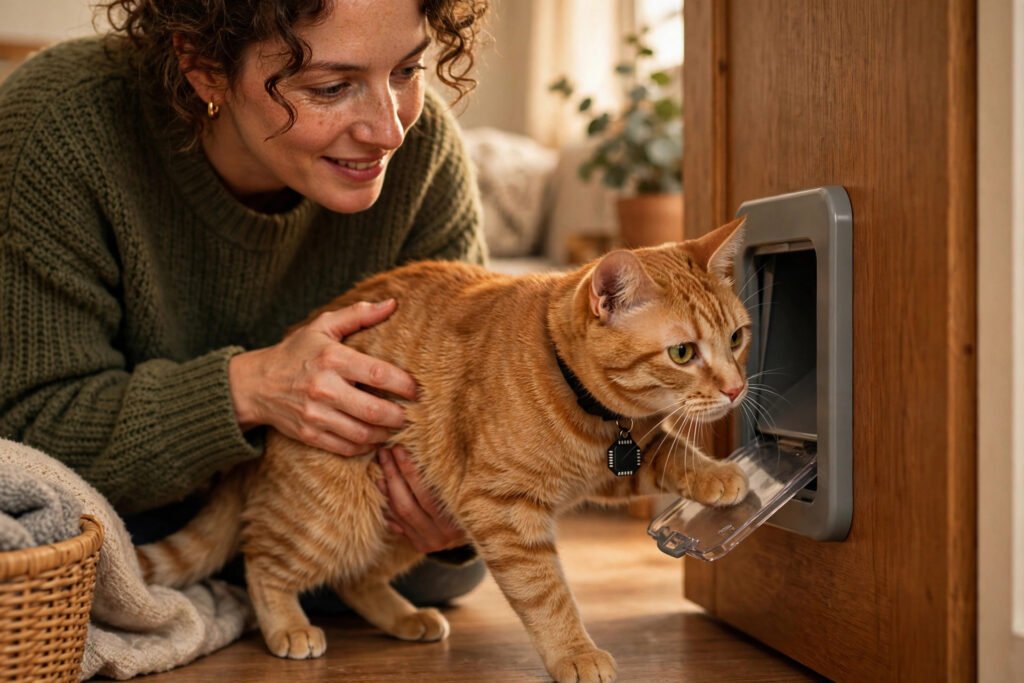
A microchip cat flap does not know your cat until you introduce them, and the introduction takes about a minute per cat. Owners sometimes imagine programming is the technical part of the installation — in truth it is the simplest part, provided it is done calmly and in the right order. This walkthrough of programming your cat’s chip into the flap explains how to program a microchip cat flap properly: what learn mode actually does, how pairing day runs, and the small mistakes that make a first attempt fail when nothing is wrong with the flap at all.
What the flap is actually learning
A microchip flap from SureFlap or PetSafe reads one thing: the unique 15-digit number of your cat’s ISO FDX-B vet microchip, the same chip a vet implants between the shoulder blades. In learn mode, the flap listens for a chip passing through its tunnel, captures that number and stores it on its list of permitted cats. From then on, when a cat puts its head into the tunnel, the reader checks the number it finds against the list. A match releases the lock for a few seconds — long enough for the cat to push through — and no match leaves the flap locked.
Nothing about your cat is stored anywhere else, and the flap holds no other information: it is a number on a list, checked at the tunnel. That is why pairing works cat by cat, and why a cat whose chip is not registered is treated exactly like a stranger’s cat — because to the flap, until pairing day, it is one.
How to program a microchip cat flap, step by step
Step 1: Settle the flap before you settle the cat
Put fresh batteries in, fit the flap, and let it sit powered for a short while before pairing anything. Cats investigate new objects in their own time; a flap that has been in the door for an hour, smelling of the house rather than the box, is a far less suspicious object than one installed thirty seconds ago. Keep the rest of the household out of the room — pairing is a one-cat audience event.
Step 2: Enter learn mode
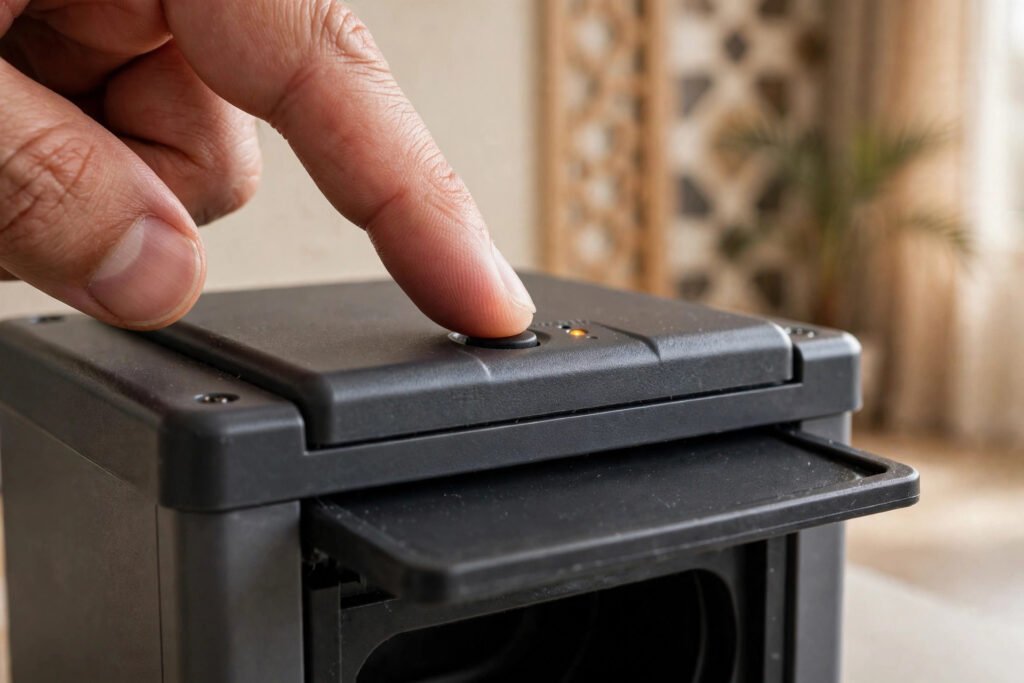
Press the flap’s memory or learn button as its instructions direct — typically a single press that lights an indicator and opens a pairing window. During that window, the next chip the reader sees in the tunnel is the chip it stores. The window is generous, so there is no need to rush the cat, and rushing is the one thing guaranteed to slow the whole business down.
Step 3: Let the cat do the pass itself
Lure your cat through the tunnel with whatever it finds irresistible on the far side — dinner is the classic, served a little late so it arrives motivated. The cat must put its own head and shoulders into the tunnel, because the reader sits in the tunnel arch and the chip sits between the cat’s shoulder blades: head in, chip in range. A cat carried to the flap and held near it often does not register, because the chip never gets close enough to the arch. A cat walking through for its tea registers every time.
Step 4: Confirm, then repeat for the next cat
The flap confirms the store — an indicator change or the lock’s behaviour — and the cat is on the list. Test it once in normal mode: cat approaches, lock releases, cat passes. Then bring in the next cat and repeat the whole sequence. Register each cat separately, on its own pass, so you know every number on the list belongs to a cat you can name.
The mistakes that make pairing seem to fail
- Pairing with the flap still in learn confusion. If a first attempt is interrupted, reset learn mode cleanly and start that cat again rather than layering half-attempts.
- Two cats in the room. A second cat wandering through mid-pairing can get its chip read instead — amusing, but it leaves the intended cat unregistered. One cat at a time, door closed.
- Holding the cat to the reader. The chip is between the shoulder blades; a cat held by a person usually presents its head, not its shoulders, to the arch. Self-propelled passes register; held cats often do not.
- Pairing before the cat is chipped. It sounds obvious, but a rescue cat’s paperwork does not guarantee a working chip. If a cat will not pair after several genuine passes, have your vet scan it — chips can occasionally fail or migrate, and the vet’s reader settles the question in seconds.
- Judging it too soon. Pair on a calm stomach and a calm evening. A cat already suspicious of the new flap needs the flap to be furniture first and a lesson second.
Once a cat is registered, no re-pairing is needed for daily life — the list survives battery changes on the models we fit, and new cats joining the household are simply added with the same routine, one pass each.
Frequently asked questions
How many cats can one flap remember?
More than any household needs — the flaps we fit store a long list of chip numbers, so multi-cat homes register every cat on the one flap. Each cat is added individually with its own learn-mode pass.
Do I need to pair the flap with anything else, like a phone or hub?
No. The microchip flaps we fit from SureFlap and PetSafe work on their own at the door: the chip in your cat and the list in the flap are the whole system. Programming is a button press and a cat walking through a tunnel.
What if my cat is not microchipped?
Then chipping comes first — a quick vet visit for the ISO FDX-B chip that vets across the UAE fit as standard. Once the chip is in and confirmed with the vet’s scanner, pairing day proceeds exactly as described here.
My cat paired but my other cat still gets in. Why?
Check the second cat is actually being kept out: if it follows your registered cat through in the same opening — tailgating — the flap is behaving correctly and the cats have simply outsmarted the timing. If it enters alone, unregistered, the lock may be set to a manual or unlocked mode rather than microchip mode.
Can I remove a cat from the list?
Yes — the stored list can be cleared and rebuilt. Most owners do this only when a cat leaves the household; a full reset followed by fresh pairings for the remaining cats takes a few minutes, one pass per cat.
We pair every cat before we leave
When we fit a microchip flap, pairing your cats is part of the job — and if you are setting one up yourself, WhatsApp us on +971 52 443 2655 and we will talk you through how to program a microchip cat flap for each of your cats. You can also email admin@petdoorfix.com. We fit microchip cat flaps across all seven UAE emirates. Need it fixed in the UAE? PetDoorFix replaces chewed, broken and worn flaps across the UAE — see our flap repair and replacement.
Instant WhatsApp Photo Quote
Send a photo of your door, your pet's size, and your area.
WhatsApp Photo QuoteNext guide: Microchip Flap Not Reading Your Cat? A Troubleshooting Checklist