
The best flap in the wrong place will be ignored, while a well-placed flap becomes part of your cat’s routine within days. Deciding where to install a cat flap is therefore less about the door you first think of and more about the routes your cat already takes, the glass you have, and how your household moves through the space. Our complete guide to choosing where a cat flap should go covers fitting methods for each location; this article walks through the thinking that leads to the right spot.
Start with the route your cat already uses
Cats are creatures of fixed paths. Long before a flap is fitted, your cat has already decided where the door to the outside ought to be, and the closer the flap is to that chosen route, the faster it will be accepted.
Watch the waiting places
Notice where your cat sits when it wants to go out. Most cats wait at one particular door or window, often the sliding door to the balcony or garden, because that is where they have always been let out. A flap on or beside that route asks the cat to learn almost nothing new.
Think about the outside of the route too
The flap should open onto a place your cat actually wants to be — a balcony, terrace or enclosed garden — with a clear landing and no sudden drop or obstacle. Inside, there should be a clear run-up rather than a flap hidden behind furniture, bins or a litter tray the cat must squeeze past.
Avoid inventing a new route
A flap placed on a rarely used door at the other end of the home may look tidy on paper, but many cats simply will not adopt it. They will keep waiting at their usual door, and you will keep opening it. Position follows the cat, not the other way round.
Where to install a cat flap in glass: panels, sliders and side lights
In UAE apartments and villas, glass is usually the practical route, and there is more choice within it than most owners expect.
The fixed side panel
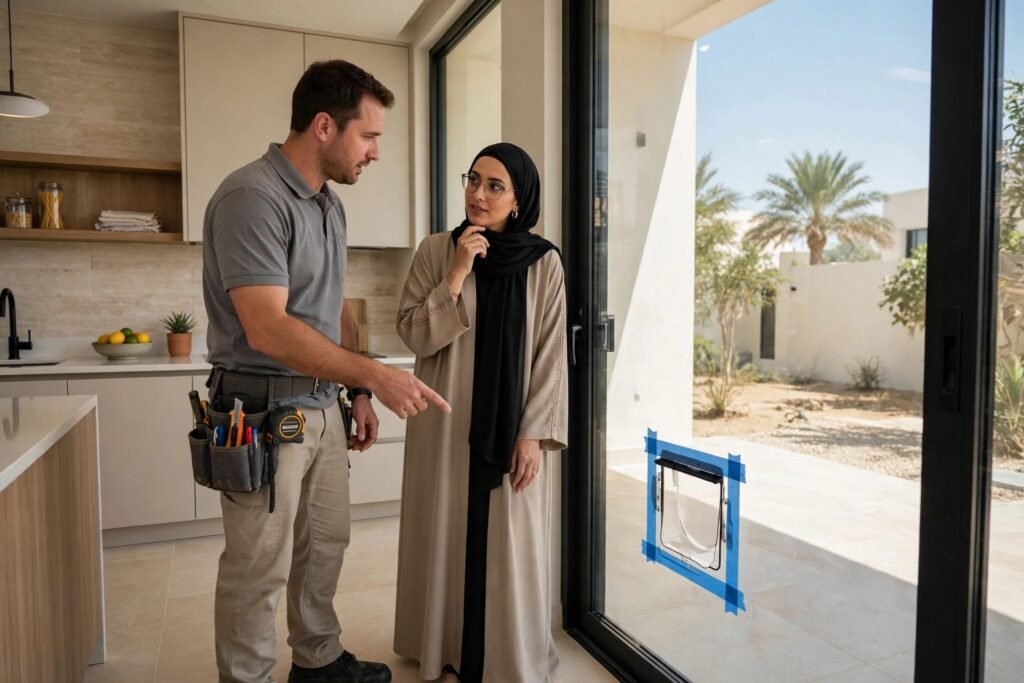
Many sliding doors sit beside a fixed glass panel, sometimes called a side light. Fitting the flap in that fixed panel is often the neatest solution of all: the sliding door keeps its full opening, the flap is always accessible, and the cat’s route stays exactly where it always was. For many homes, this is the position we recommend first.
A sliding door insert
Where there is no suitable fixed panel, a flap can sit in an insert that runs in the sliding door track. Booked before 10 AM, an insert in the standard white aluminium frame with clear glass can be fitted the same day; a custom RAL powder-coated frame takes 2–3 days. The trade-off is that the insert takes part of the doorway width, so it suits wider sliders best.
A replacement glass panel
A flap can also be fitted into a made-to-measure replacement panel for the door itself. Your original glass is stored safely and swapped back in 30 minutes when you move, keeping the work 100% rental-friendly with no landlord NOC needed. Glass type matters here: toughened and double-glazed units are made to order as sealed replacements, and if your glass has a reflective finish, a shade match cannot be guaranteed 100%.
Weighing quiet spots against busy doors
Position is also about what happens around the flap all day, not just the route through it.
Foot traffic and noise
A flap on the household’s busiest door competes with people, pushchairs, shopping bags and constant sliding. Cats prefer a calmer threshold. A side panel or a quieter door gives the cat a moment to pause, check the other side and pass through without being jostled — particularly important for nervous cats and for microchip models, where the cat needs a brief moment at the reader.
Draughts, sun and cooled air
In the UAE, a flap on a west-facing panel in full afternoon sun will be approached through a wall of heat, and any opening in your glazing should seal well to keep cooled air in. Well-made flaps close firmly behind the cat, but position still helps: a shaded or sheltered spot is kinder on the cat and on your cooling.
Other pets and other doors
In a multi-pet home, one well-placed flap on the shared route usually serves everyone better than two flaps on different doors. Bear size in mind together with position: cats over 4kg need a Large flap, and the position must give a bigger cat a straight, level approach rather than an awkward turn.
Positions that rarely work well
Some spots fail for predictable reasons. A flap that opens directly onto a busy communal corridor in an apartment building puts your cat among strangers and other animals the moment it leaves. A flap positioned where furniture must be moved every time the door slides will be blocked half the time. A flap at the top of steps, or one the cat must jump up to reach, discourages all but the boldest cats. And a position chosen to hide the flap from human view often hides it from the cat’s natural route as well — the cat’s convenience has to come first, or the flap will not be used.
Frequently asked questions
Is a fixed side panel better than the sliding door itself?
Often, yes. A flap in the fixed panel leaves the sliding door free to open fully, keeps the cat’s route unchanged, and is always accessible. It depends on the panel’s size and glass type, which we confirm from photos before fitting.
Can a cat flap go in a double-glazed door?
Yes. The flap is fitted into a new made-to-measure sealed unit that replaces the existing one, rather than by cutting your original unit. Your original glass is stored and can be swapped back in 30 minutes.
Will a flap in glass affect my sliding door’s opening?
A flap in a fixed side panel does not affect the opening at all. An insert in the track takes part of the width, so on narrower doors we usually discuss the panel options first.
My cat waits at a window rather than a door. Can a flap go there?
In many cases a flap can be fitted in a glass panel below or beside a window, provided the panel is large enough and the outside landing is safe. Send us a photo of the window and the area outside and we will advise.
Does position matter for a microchip flap?
Yes, a little more than for a manual flap. The cat needs a calm, level approach so the reader can scan its chip as it reaches the flap. A quiet position away from heavy foot traffic suits microchip models best.
Talk to us about the right spot in your home
If you are still weighing up where to install a cat flap, send us photographs and let us look at your actual doors and panels with you. WhatsApp us on +971 52 443 2655 with a photo of each door or panel you are considering, plus your cat’s breed and approximate weight, and we will recommend the position and size. You can also email admin@petdoorfix.com. We install across all seven UAE emirates, and glass fittings stay rental-friendly, with your original glass stored for a 30-minute swap-back.
Instant WhatsApp Photo Quote
Send a photo of your door, your pet's size, and your area.
WhatsApp Photo QuoteNext guide: Cat Flap Height: Fitting the Flap at Your Cat’s Belly Height