
Not every cat in a home lives by the same rules. One cat may be confident outdoors, used to the garden or balcony and perfectly happy coming and going, while another is an indoor-only cat who should never be outside at all — perhaps because of age, health, temperament, or simply because that is the life that suits them best. A single ordinary flap cannot tell those two cats apart. A selective exit microchip cat flap can, because it recognises each cat individually and applies a different exit rule to each one. Our guide to selective-exit flaps for indoor cats explains the models and fitting options in full; this article looks at how per-cat permissions work in daily life.
How selective exit works, cat by cat
A standard microchip flap mainly controls who comes in. It reads the chip of a cat approaching from outside and unlocks only for registered cats, which keeps strays and neighbours’ cats out. Exit, on a basic model, is usually open — any cat inside can push out.
Selective-exit models add control in the other direction. This type of feature, often described as DualScan, reads the cat’s chip on the way out as well as on the way in. Each registered cat can then be given its own setting: free to leave and return, free to return but not to leave, or kept indoors while still being recognised by the flap.
Each cat is recognised by its own chip
The flap reads the pet’s existing 15-digit ISO FDX-B vet chip, the same chip implanted by vets across the UAE. During set-up, each cat is registered individually, so the flap is never guessing from size or colour. It knows exactly which cat is standing at the door, and it applies that cat’s rule.
Permissions can be changed as life changes
A cat who is kept in after an operation, a new kitten who is not yet ready for the outdoors, or an older cat who has retired from roaming can all have their setting adjusted without changing the flap itself. When circumstances change again, the setting changes with them.
Why a selective exit microchip cat flap suits mixed households
Mixed households are more common than most people expect, and they are exactly where selective exit earns its place.
The confident outdoor cat
An outdoor cat who is suddenly locked in because a housemate must stay indoors will usually protest loudly and persistently. With per-cat permissions, that cat keeps its normal routine. It leaves and returns through the same flap, on the same schedule, as if nothing had changed.
The indoor-only cat
Some cats are indoor cats for life. They may be nervous outdoors, unsuited to traffic and stray encounters, or kept in on veterinary advice. For them, the flap is not a door at all — it stays locked in the outward direction, so a curious moment at the glass does not become an escape.
New arrivals and foster cats
When a new cat joins a home, there is often a settling period indoors before any outdoor access is considered. Selective exit lets the established cats carry on as normal while the newcomer stays safely in.
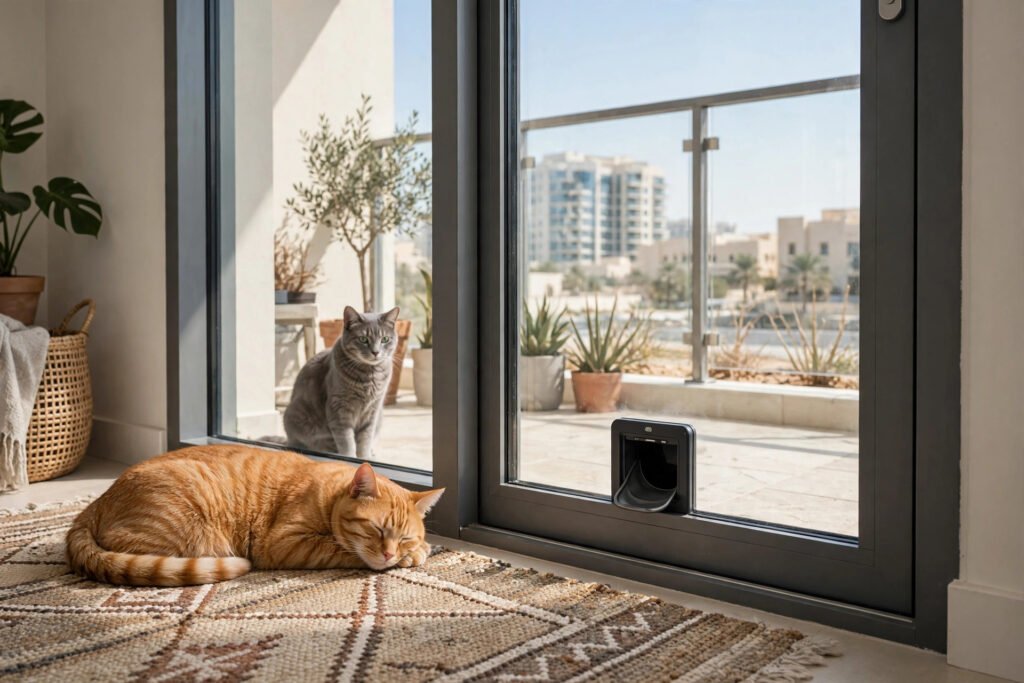
Fitting selective-exit flaps in glass and sliding doors
Selective-exit models are fitted in the same places as other microchip flaps. In a glass door or window, the flap sits in a made-to-measure replacement panel. Your original glass is stored safely and can be swapped back in 30 minutes when you move out, which keeps the installation 100% rental-friendly with no landlord NOC needed.
In a sliding door, a flap can sit in a panel in the track instead. If you book before 10 AM, a sliding insert in the standard white aluminium frame with clear glass can be fitted the same day; a custom RAL powder-coated frame takes 2–3 days. One honest note on glass: if your existing glass has a reflective finish, a shade match on a new panel cannot be guaranteed 100%.
Choosing the right size
Sizing follows the cat, not the setting. Most cats suit a standard flap, but cats over 4kg need a Large flap — a rule that covers many British Shorthairs, Ragdolls, Maine Coons and sturdy Arabian Maus. Brands such as SureFlap and PetSafe make microchip flaps with this kind of selective control, and we confirm the right model and size against each cat’s details before fitting. We fit across all seven UAE emirates, from city apartments to family villas.
Helping your cats learn the new rules
Most cats adapt quickly, because nothing about the flap feels different — it simply opens for one cat and not for another, depending on the direction and the setting.
Introduce the flap with exit settings open
If all of your cats are allowed out at first, start that way. Let everyone learn that the flap is their door, then apply the indoor setting to the cat who needs it once the routine is established. A cat who already trusts the flap is less likely to be unsettled by it.
Watch the first few days
An indoor cat who discovers the flap no longer opens outward may try it a few times and then lose interest. Keep litter, water, scratching and play well away from the door so staying in never feels like a punishment.
Keep every cat registered
Selective exit only works for cats the flap can recognise, so register every cat in the household — including those set to stay in.
Frequently asked questions
What is the difference between a standard microchip flap and a selective-exit model?
A standard microchip flap controls entry, unlocking only for registered cats coming in, while exit is generally open. A selective-exit model also reads the chip on the way out, so each cat can have its own exit permission.
Can one cat go out while another stays in through the same flap?
Yes. That is the central purpose of selective exit. Each cat is recognised by its own chip, so the outdoor cat passes freely while the indoor-only cat finds the flap locked in the outward direction.
Does my cat need a special chip for selective exit?
No. These flaps read the pet’s existing 15-digit ISO FDX-B vet chip. If your cat was chipped by a UAE vet, that chip is almost certainly the compatible type, and a quick vet scan can confirm it.
What happens if my indoor cat follows the outdoor cat to the door?
The flap reads the chip of the cat at the door at that moment. If the indoor cat presents itself and its setting is to stay in, the lock stays engaged for that cat, even though it opens for its housemate.
Can I change a cat’s exit permission later?
Yes. Permissions are a setting, not a permanent choice. A cat recovering indoors can be given outdoor access again later, and a cat who needs to stay in can have its exit closed, without any change to the fitted flap.
Talk to us about selective exit for your cats
If you share your home with cats who live by different rules, a selective exit microchip cat flap can give each of them exactly the freedom they should have. WhatsApp us on +971 52 443 2655 with a photo of the door or glass panel and a note about each cat’s breed, weight and whether they go outdoors, and we will confirm the right model and size. You can also email admin@petdoorfix.com. We fit across all seven UAE emirates, and every glass installation stays rental-friendly, with your original glass stored and ready to swap back in 30 minutes.
Instant WhatsApp Photo Quote
Send a photo of your door, your pet's size, and your area.
WhatsApp Photo QuoteNext guide: How Microchip & Collar-Sensor Cat Flaps Work (And Whether Your UAE Vet Chip Is Compatible)