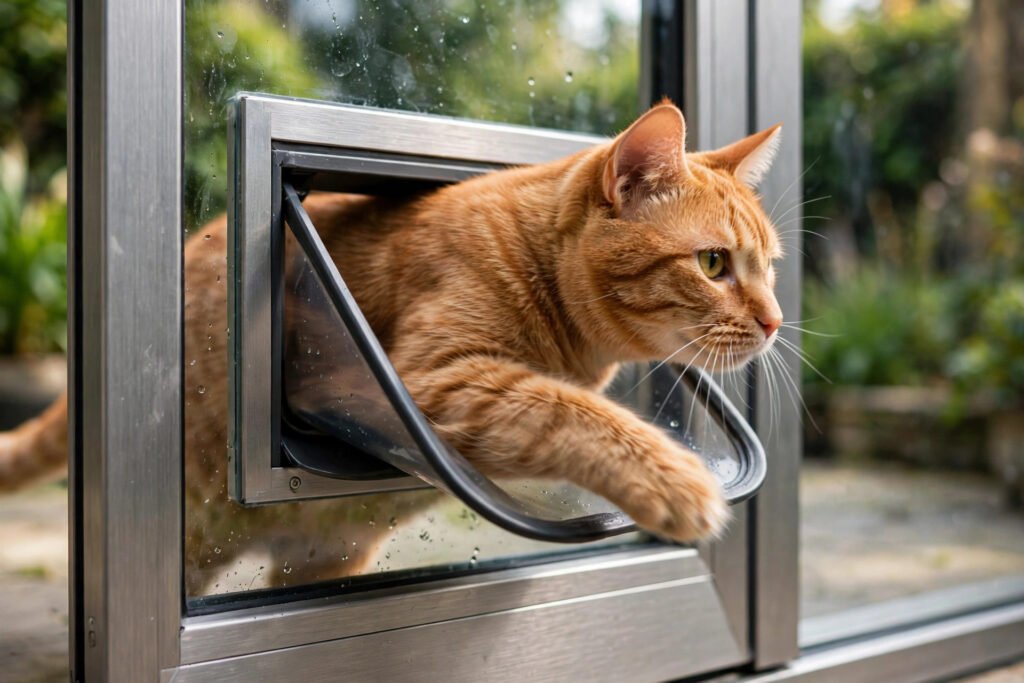
Most cat flaps are sold as if cats came in one size, and many UAE cats simply do not. If your cat weighs over 4 kg — as most British Shorthairs, Ragdolls, Maine Coons, Persians and adult Arabian Maus do — a standard flap is likely to be a tight squeeze at best and a reason to stop using it at worst. This guide explains the 4 kg rule we fit by, the signs a flap is too small, and what a Large flap changes.
See our guide to cat flap installation for the full service.
The 4 kg rule: why weight is the starting point
Every cat fitting we do starts with the same question: what does the cat weigh? Weight is not a perfect measure of size, but it is the most reliable quick guide to the body that has to pass through the opening — the width of the shoulders and chest, and the depth of the body that must clear the frame without scraping.
Our rule is simple: any cat over 4 kg needs a Large flap. Below that weight, a standard flap is usually a comfortable fit. Above it, owners report the same cluster of problems — hesitation at the flap, a wriggling sideways shuffle to get through, or a cat that goes out through the flap but sits outside meowing to be let back in. None of that is stubbornness. It is a cat deciding the squeeze is not worth it.
Sizing up from the start is far better than replacing a flap the cat has already learned to dislike. Our full guide to large cat flap installation UAE sets out the sizes and models we fit.
The UAE breeds that outgrow a standard flap
Certain breeds popular in UAE homes are almost guaranteed to cross the 4 kg line as adults, often by a comfortable margin.
British Shorthair
The British Shorthair is built like a small barrel: a broad chest, dense body and thick neck. At a healthy weight it is a wide cat in every direction, and width is exactly what a standard flap runs out of first.
Ragdoll and Maine Coon
Ragdolls are long, heavy-bodied cats that keep filling out well into adulthood, and Maine Coons are larger again — tall, heavy and deep-chested. For these breeds the issue is not just width but the whole cross-section of the cat: shoulders, chest and back all need clearance at the same moment.
Persian and Arabian Mau
Persians carry a stocky, compact body under a great deal of coat, and the coat itself adds to the effective width the flap sees. The adult Arabian Mau — the UAE’s own breed, lean and athletic rather than bulky — still commonly passes 4 kg, and a tall, muscular Mau needs the headroom and shoulder room of a Large flap even though it looks slimmer than a British Shorthair. If your cat belongs to any of these breeds, plan for Large from the beginning.
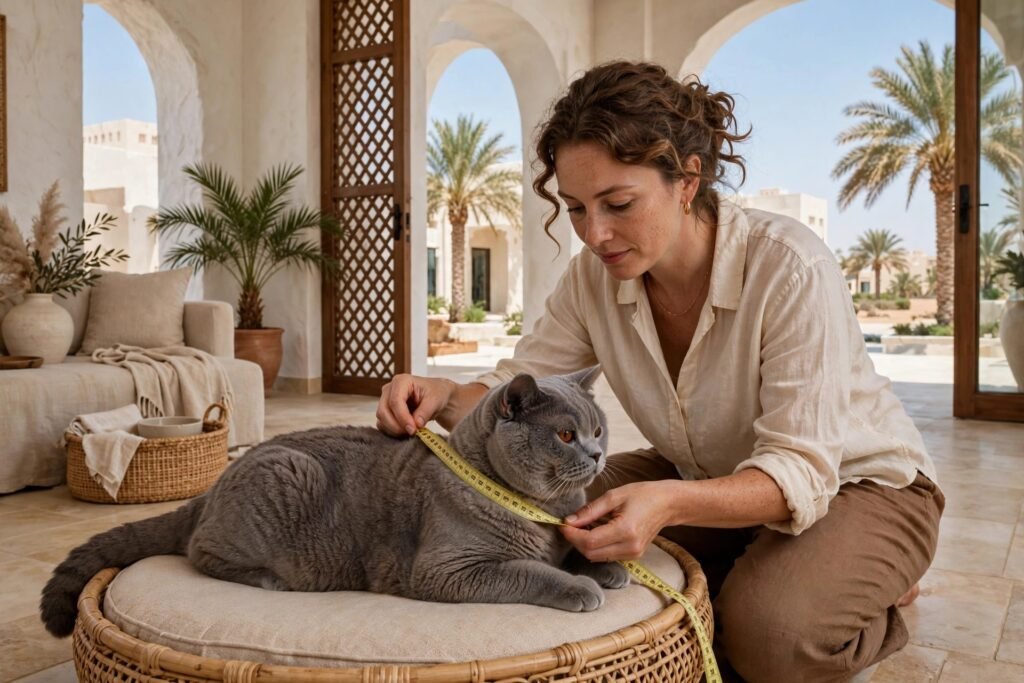
Signs your cat is struggling through a standard flap
Cats rarely announce that a flap is too small. They show it in behaviour owners often read as fussiness.
Watch for a cat that approaches the flap, lowers its head, then backs away and tries again — or gives up and waits by the door. Listen for the flap rubbing along the cat’s back as it passes, and look for a sideways, angled entry, where the cat turns its shoulders to fit diagonally through the opening. A cat that goes out through the flap but refuses it on the way back is a classic case: the squeeze feels worse from the less familiar side.
Young cats hide the problem for a while: a kitten fitted with a standard flap may pass through easily, then grow into a broad adult and quietly stop using it. If a previously reliable user changes its habits after a growth spurt, check the fit before assuming the flap is faulty.
What a Large flap actually changes
A Large flap is not just a standard flap with a taller door. The opening itself is wider and higher, so the cat’s shoulders clear the sides and its back clears the top in one straight, confident movement. That clearance matters for microchip models in particular: the reader has to meet the chip between the cat’s shoulder blades as it approaches, and a cat ducking and twisting through a tight opening makes that read less reliable than a cat walking straight through at natural height.
Large options: microchip and manual
Sizing up does not mean giving up features. The Large choice exists on both routes we fit.
Microchip Large flaps from SureFlap and PetSafe read your cat’s existing veterinary microchip and open only for your cat, keeping stray and neighbourhood cats out — two problems solved with one flap where strays visit.
Manual four-way locking flaps open for any cat but can be set to in-only, out-only, fully open or fully locked. Closer Pets models are supplied for manual four-way locking only, as are the manual models in the SureFlap and PetSafe ranges.
What we will not do is squeeze a large cat into a standard model of the brand you first had in mind. Size comes first, brand and features second — an elegant flap the cat refuses is worse than no flap at all.
Where a Large flap can be fitted
A Large flap goes anywhere a standard flap goes. In glass, it is fitted into a made-to-measure replacement panel, most often in a sliding or double-glazed door. That fitting stays 100% rental-friendly: your original glass is stored safely and swapped back in 30 minutes when you move out, with no landlord NOC needed. A Large flap can also sit in a sliding track insert panel, and the same sizes suit wooden doors, walls and other solid panels, with the flap’s height set from your cat’s size at fitting.
Frequently asked questions
How do I know if my cat is over 4 kg?
Weigh your cat at the vet, or weigh yourself holding the cat and then without it on bathroom scales and subtract. Most adult British Shorthairs, Ragdolls, Maine Coons, Persians and Arabian Maus are over 4 kg even at a healthy weight, so breed alone is a strong guide.
My cat manages its standard flap. Should I still change it?
If it passes through cleanly without rubbing, hesitating or angling its shoulders, the fit is doing its job. If you see the struggle signs above — backing away, scraping, refusing the return trip — a Large flap is the fix, not retraining.
Can a Large flap still keep stray cats out?
Yes, in a microchip model. Large microchip flaps from SureFlap and PetSafe read your cat’s own chip and stay locked to every other cat, exactly as the standard sizes do.
Is a kitten too small for a Large flap?
A kitten will grow into it, and fitting Large from the start avoids replacing the flap at adult size. Very small kittens should be supervised with any flap until they can push the door comfortably on their own.
Does a Large flap affect the rental swap-back?
No. Standard or Large, a glass flap is fitted in a replacement panel, your original glass is stored uncut, and the swap-back at move-out takes 30 minutes.
Talk to us about sizing your cat properly
WhatsApp us on +971 52 443 2655 with your cat’s breed and approximate weight and a photo of the door or panel, and we will confirm whether a Large flap is right and which model suits it. You can also email admin@petdoorfix.com. We fit across all seven UAE emirates.
Instant WhatsApp Photo Quote
Send a photo of your door, your pet's size, and your area.
WhatsApp Photo QuoteNext guide: Step-by-Step Training Guide: Helping Shy Cats & Dogs Master Magnetic & Microchip Flaps