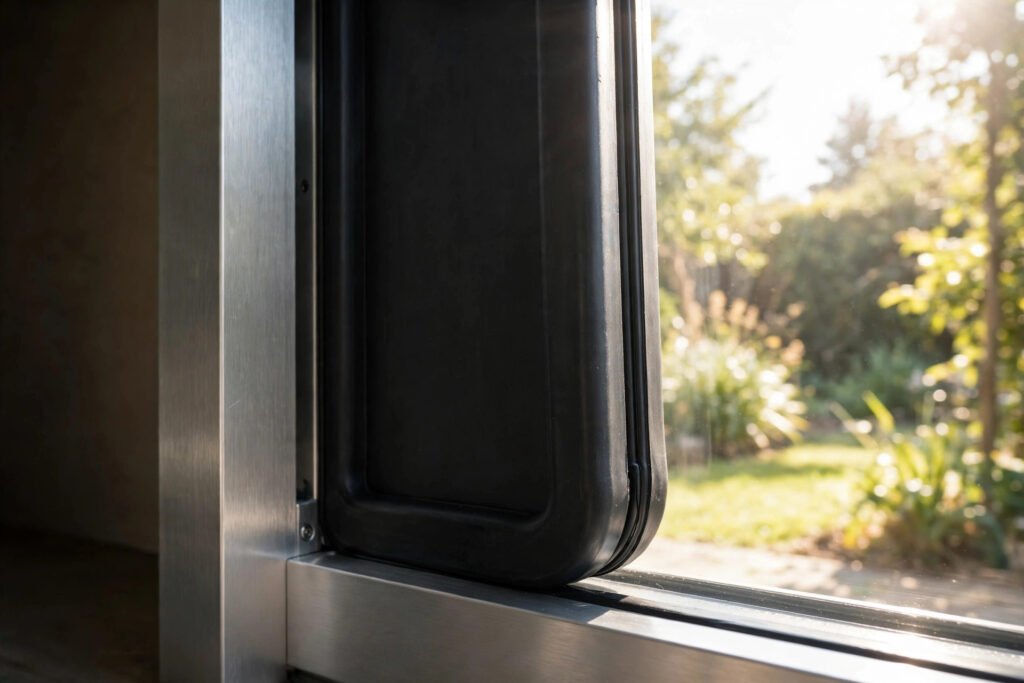
Most dog door problems start with a single mistake: the wrong size. A flap that is too small makes a dog duck, twist and eventually refuse to use the door it was bought for, while the right size is used confidently from the first day. This chart sets out the three sizes we fit in the UAE, the breeds each suits, and — most importantly — how to measure your own dog, because measurement settles what breed labels only suggest.
See our guide to dog door installation for the full service.
The size chart by breed
| Size | Flap opening | Breeds it suits |
|---|---|---|
| Medium | 23×35 cm | Bulldog, Shih Tzu, Poodle |
| Large | 28×45 cm | Beagle, Pointer |
| X-Large | 36×65 cm | Labrador, Golden Retriever, Husky, Great Dane |
Read the chart as a starting point, not a verdict. Breeds vary — a compact female Labrador and a tall male from working lines are different dogs — and two dogs of the same breed can fall either side of a size boundary. That is why our custom sized dog doors in UAE are always confirmed against your dog’s actual shoulder height and width before anything is made or fitted.
How to measure your dog, step by step
You need a tape measure, a wall and a dog standing reasonably still. A second pair of hands and a treat for cooperation both help.
Step 1: Measure the shoulder height
Stand your dog squarely on a hard floor, up against a wall, with its head up in a natural position — not stretched up begging and not crouched. Find the highest point of the shoulder blades, the ridge between them at the base of the neck. Mark that height on the wall with a light pencil line level with the shoulders, step the dog away, and measure from the floor to the mark. That figure is the shoulder height, and it is the number the flap height must clear: your dog will pass through the flap with its head lowered a little, but it should not have to crouch or crawl to do it.
Step 2: Measure the widest width
Measure across the widest point of your dog — usually the chest or shoulders, whichever is broader. The flap opening must be wider than that measurement with room to spare, because a dog does not pass through a door edge-on like a letter through a slot. It walks through at a slight angle, with its coat, and often at a trot. A width that only just fits on paper will rub, catch and put the dog off.
Step 3: Match the measurements to the chart
Take the larger of the two requirements. If your dog’s height points to Large but its width needs more room, the width wins — size up. Dogs close to a boundary between sizes are almost always happier in the bigger flap, and a slightly generous door costs the dog nothing, while a slightly tight one costs it confidence every day.

Rise height: the measurement owners forget
The rise is the height of the bottom of the flap opening above the floor — the step your dog must lift its legs over on every pass. Rise height is set when the door is fitted, and getting it right matters as much as the flap size itself.
The guidance is straightforward. The rise should be low enough that your dog steps over it comfortably without catching its belly or chest on the bottom of the opening, and no higher than it needs to be for the panel the flap sits in. Short-legged dogs need a low rise — a step that is trivial for a Labrador can be a real barrier to a Shih Tzu. Older dogs and dogs with stiff joints also manage a lower rise far better, and a dog that is young and athletic now will not be forever, so we set the rise for the dog’s comfort over the door’s whole life, not just this year.
When you send us your measurements, tell us your dog’s approximate leg length or belly clearance as well as shoulder height, and we will set the flap height in the panel accordingly.
Common sizing mistakes
- Sizing by breed label alone. The chart gives the typical size for each breed, but your individual dog’s measurements decide. Always measure.
- Sizing for the puppy. A young Labrador bought a Large will outgrow it. If your dog is still growing, tell us — we will size for the adult dog it will become.
- Forgetting the rise. A correctly sized flap set too high off the floor still fails the dog, particularly short-legged and older dogs.
- Choosing the smaller size at a boundary. A dog at the top of one size belongs in the next size up. Tight flaps are the main reason dogs hesitate, force their way through or stop using a door.
Where the sized door can go
Once the size is settled, it can be fitted in glass, in a sliding door insert, in a wooden door or through a wall. In glass, the flap sits in a made-to-measure replacement panel: your original glass is stored and swapped back in 30 minutes when you move out, so the fitting is 100% rental-friendly with no landlord NOC. For sliding doors, our standard white frame and clear glass insert can be fitted the same day if booked before 10 AM, and custom RAL powder-coated finishes take 2–3 days. In every case the size chart and the measurements come first — the location changes the panel, not the size your dog needs.
For dog doors we fit Hakuna Pets and PetSafe, whose magnetic seals pull the flap shut behind your dog, keeping cooled air in and the 45°C heat and dust out.
Frequently asked questions
What size dog door does a Labrador need?
X-Large, at 36×65 cm. The same size suits Golden Retrievers, Huskies and Great Danes. Confirm with your own dog’s shoulder height and width before fitting, as individual dogs vary.
My dog’s breed is not on the chart. How do I choose?
Ignore the label and measure. Take the shoulder height and the widest width as described above, match them against the three flap openings — 23×35 cm, 28×45 cm and 36×65 cm — and size up if your dog falls between sizes. Send us the measurements and we will confirm the size for you.
What if my dog is between two sizes?
Choose the larger size. A dog will use a slightly generous flap confidently, while a slightly tight flap makes it duck and twist, which is how dogs learn to avoid a door.
How high off the floor should the flap be?
Low enough for your dog to step over comfortably without catching its belly: that is the rise height. Short-legged and older dogs need it lower. We set the rise when fitting, based on your dog’s leg length and clearance, which is why we ask for those details too.
Does the same chart apply to sliding door inserts?
Yes. The flap sizes are the same wherever the door goes — glass panel, sliding insert, wooden door or wall. The opening is chosen for the dog; only the panel around it changes.
Send us your measurements
WhatsApp us on +971 52 443 2655 with your dog’s breed, shoulder height and widest width — plus a photo of the door or glass panel where the flap will go — and we will confirm the right size before anything is made. You can also email admin@petdoorfix.com. We fit dog doors across all seven UAE emirates.
Instant WhatsApp Photo Quote
Send a photo of your door, your pet's size, and your area.
WhatsApp Photo QuoteNext guide: Why Standard UK & European Pet Flaps Fail in 45°C UAE Summers (And What Works Instead)