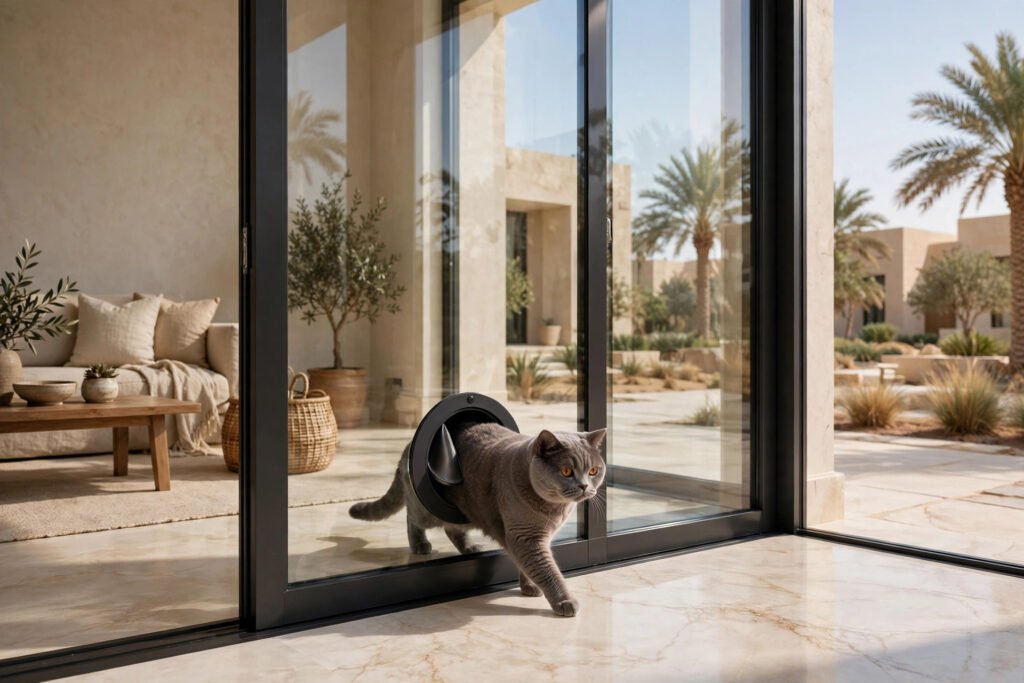
Most UAE villas offer more than one pane a pet flap could go into: a fixed floor-to-ceiling panel, a single openable door, a sliding door, or French or bifold doors. Choosing the right pane matters more than choosing the flap — it makes the fitting simpler, keeps your everyday door working as it does now, and gives your pet a sensible route in and out. Choosing between a fixed cat flap glass panel and a flap in an openable door is the first decision most owners face.
See our guide to double-glazed glass pet doors for the full service.
The principle: fit the pane, not the door you rely on
A pet flap in glass is fitted by replacing a pane, never by cutting the glass you have. Tempered villa glass cannot be cut on site, so the chosen pane is removed intact, stored, and replaced with a new tempered panel made with the flap opening already in it. Whenever you want it reversed, your original pane goes back in — a swap-back that takes 30 minutes.
That makes the real decision which pane to swap. Our work with custom glass panel pet doors follows one rule: pick the pane whose replacement is lightest and simplest, on the route your pet will actually use, and leave the main doors doing their normal job.
Fixed floor-to-ceiling panels: often the smartest choice
Many villa living spaces are mostly fixed glass — wide floor-to-ceiling panels that never open, flanking one door that does. Those fixed panels are frequently the best home for a pet flap, for three reasons.
First, a fixed panel has no daily job to disrupt. The door your family opens constantly keeps working exactly as it does; the pet gets a dedicated opening in glass nobody needed to move.
Second, there is often a smaller fixed side panel in the run — a narrow pane beside the main door. Swapping that smaller pane is a lighter, simpler job than replacing a large door leaf: it is easier to handle, and easier to store safely while the replacement is in place. If your villa has one, it is very often the panel we recommend.
Third, position is flexible: the flap can sit at the end of the run nearest the garden or utility area, rather than in the middle of the door everyone uses. The one point to plan around is size — a full-width floor-to-ceiling pane is a big piece of glass to remove and store, so a smaller fixed panel in the same run usually wins on practicality alone.
Single openable glass doors: the direct route
A single hinged glass door — a back door, a garden door, a side door to a utility area — is the most obvious candidate, and sometimes the right one. If that door is the natural route between house and garden for everyone, pets included, a flap in its glass keeps one clear route for the whole household.
Fitting works the same way: the door’s pane is replaced with a new tempered panel carrying the flap, and the original is stored for swap-back. The door keeps working as a door — the flap lives in its lower glass. Choose this when the door is genuinely your pet’s route, and think twice when it is the home’s busiest entrance: some cats prefer a quiet, fixed opening of their own to timing trips around swinging glass.

Sliding doors: two routes to choose from
With a sliding door there are two approaches, and the right one depends on the door and how you use it.
The first is a track insert: a separate made-to-measure panel in the track with the flap built in, while your original door and glass stay untouched. In standard white aluminium with clear glass it can be fitted the same day if you book before 10 AM; a custom RAL powder-coated finish takes 2–3 days.
The second is replacing the glass in a sliding panel itself, using the store-and-swap-back method — the route where an insert does not suit the track arrangement, or the flap needs to sit in the door glass itself.
French and bifold doors: choose one leaf, carefully
French doors and bifolds are made of narrower leaves, and that changes the thinking. A flap can go into one leaf’s glass — but leaf width limits the room around a flap, and large dog flaps may not suit a narrow leaf at all. With bifolds, the flap must also sit in a leaf whose folding movement it will not obstruct, and stay usable in the configuration you live with day to day. For many arrangements, the honest answer is that a nearby fixed panel is the better pane and the doors are left alone.
Size still decides: matching the pane to your pet
Whichever pane you choose, the flap is sized to your pet. Dog flaps run at Medium 23×35 cm, Large 28×45 cm and X-Large 36×65 cm — Medium for dogs such as Shih Tzus and Poodles, Large for Beagles and Pointers, X-Large for Labradors, Golden Retrievers, Huskies and Great Danes. An X-Large flap needs a generously sized pane, which is why big dogs are usually fitted in a wide fixed panel or sliding door rather than a narrow French leaf. For dog doors we fit Hakuna Pets and PetSafe, with magnetic seals.
For cats, any cat over 4 kg needs a Large flap — many British Shorthairs, Ragdolls and Maine Coons included. Cat flaps are manual four-way locking models, or microchip models from SureFlap and PetSafe that open only for your cat’s microchip and keep strays out. Closer Pets is supplied for manual four-way locking only.
One honest note on reflective glass
If your villa glass is reflective or tinted, we say this upfront: a new panel’s shade cannot be guaranteed 100% identical to the original, because architectural glass shades vary between batches and suppliers. We match as closely as the glass allows — and your original pane is stored unaltered, so its exact shade goes back in at swap-back.
Frequently asked questions
Which pane is usually best for a pet flap in a villa?
Very often a smaller fixed side panel beside the main door: a lighter, simpler swap than a large door leaf, which does not affect your daily door, with the original pane stored for swap-back.
Can a flap go into the glass of a hinged back door?
Yes. The door’s pane is replaced with a new tempered panel made with the flap opening in it, the door keeps working as a door, and your original glass is stored for swap-back.
Is a sliding door flap an insert or a glass replacement?
Either. An insert is a separate panel in the track that leaves your door untouched; a glass replacement suits layouts where an insert is not the right fit. We confirm which applies from a photo of your door.
Can French or bifold doors take a pet flap?
Sometimes, by replacing the glass in one leaf — but narrow leaves limit flap size, and bifold movement has to be considered. Often a fixed panel nearby is the better choice.
My dog needs an X-Large flap. Does that change the pane choice?
Yes. An X-Large flap at 36×65 cm needs a wide pane, so a generous fixed panel or a sliding door is usually the right home for it. Cats have their own rule: over 4 kg means a Large flap.
Send us a photo of the whole wall of glass
WhatsApp a photo of the full run of glass — fixed panels, doors and all — to +971 52 443 2655, with your pet’s breed and size, and we will tell you which pane we would fit and why. You can also email admin@petdoorfix.com. We install across all seven UAE emirates. In most homes, a fixed cat flap glass panel beside the door you walk through is the arrangement owners settle on.
Instant WhatsApp Photo Quote
Send a photo of your door, your pet's size, and your area.
WhatsApp Photo QuoteNext guide: Why You Can Never Cut Into Existing Villa Tempered Glass (And How Replacement Panels Work)