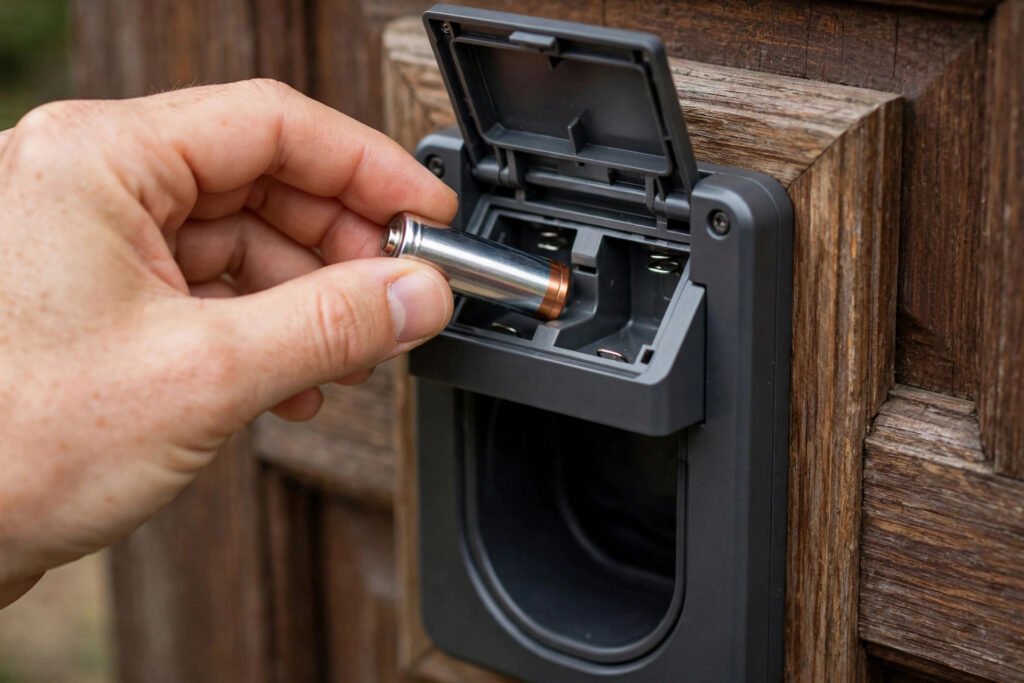
Every owner asks the same sensible question before fitting: what happens when the batteries run out — will my cat be locked out in the garden with no warning? It is the right question to ask about microchip cat flap batteries, because the flap’s reader and lock are powered, and a flap that failed silently would be worse than a manual one. Our fitting guide to microchip flap batteries and low power sits inside the wider model guide; this article explains the behaviour itself, so you know exactly what warnings you get, in what order, and what simple habits make a flat battery a non-event.
Why the flap needs power at all
A manual flap is a hinge. A microchip flap is a small, patient security guard. Its reader has to wake as a cat approaches, scan the chip in the tunnel, compare the number against the registered list, and operate the lock — all in the moment your cat’s head reaches the door. That work needs power, supplied by batteries housed in a compartment in the flap itself, reached from inside the house.
The reassuring part is how little work the flap does between visits. It draws on its batteries in short moments, when a cat is actually at the door, which is why the flap gives you notice long before they are spent. We deliberately do not quote a figure in months here, because real life varies with how many cats you have and how busy the doorway is; the indicator, not the calendar, is what should guide you.
The warnings come first, in good time
Microchip flaps from SureFlap and PetSafe are designed to announce low power rather than conceal it. As the batteries weaken, the flap shows it — typically through a low-battery indicator light, and on some models an audible prompt as the flap operates. The first warning appears while the flap is still working normally, not at the point of failure.
That gap between warning and exhaustion is the whole design. A flap that flags its batteries early gives you time, in ordinary use, to do a two-minute job. When we fit a flap, we show you where its indicator sits and what its low-power signal looks like on your model, so the first time you see it, it is familiar rather than alarming.
Learn your flap’s normal sounds and lights
The easiest way to spot a low-power warning is to know the flap on a healthy day. Notice the small click of the lock releasing as your cat passes. A new beep, a changed flash pattern or a lock that sounds less decisive than usual is the flap telling you its batteries are tired — not that it has failed, but that it is asking, in advance, for fresh ones.
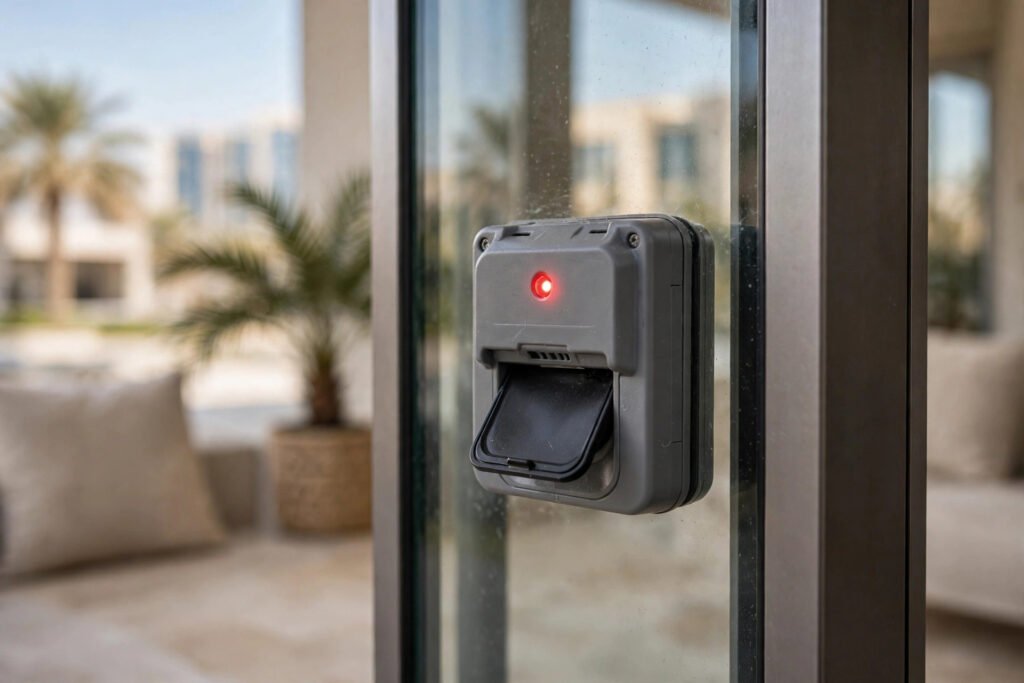
What microchip cat flap batteries do as power runs down
Handled promptly, nothing dramatic. You see or hear the warning, you replace the batteries at a moment that suits you, and the flap carries on — your cats’ registrations are held in the flap’s memory, so a straightforward battery change does not mean re-registering the household.
Left unheeded, the story is less kind. A reader needs power to scan a chip. If batteries run completely flat, the flap cannot read your cat’s 15-digit ISO FDX-B chip, so it cannot unlock for her — it rests locked, which keeps strays out but also keeps your cat waiting. That is not a silent failure; it is the end of a warning period that was there to be acted on. The flap never quietly stops recognising your cat while its batteries still have life, and it is entirely within your control never to reach the flat stage.
The habits that make it a non-issue
- Keep spares in the house. A set of the right batteries, kept in a kitchen drawer from fitting day, turns a warning light into a two-minute task instead of a shopping trip.
- Act on the first warning. Treat the indicator the way you treat a smoke-alarm chirp: not an emergency, and not something to leave for next month either.
- Change the set together. Replace all the batteries at once with fresh ones from the same pack, rather than topping up one at a time, so the set ages evenly.
- Glance as you pass. A weekly look at the flap while you feed the cat is enough. Owners who rely on the flap during holidays should check the indicator in the week before they travel, and leave spare batteries where a cat sitter can find them.
Power, visitors and the rest of daily life
Owners sometimes worry about the reader being triggered constantly — by a cat lounging against the glass, or a stray testing the flap at night. Ordinary investigations are exactly what the flap is built for, and a cat sunbathing beside the door is not draining it in any way you need to manage. A busy household with several cats will go through batteries sooner than a one-cat flat; that is another reason the indicator matters more than any general estimate.
For cats over 4 kg we fit a Large flap. The fitting itself can be in glass — with your original panel stored and swapped back in 30 minutes when you move, 100% rental-friendly with no landlord NOC needed — or in a sliding-door insert, fitted the same day if booked before 10 AM in the standard white aluminium frame with clear glass.
Frequently asked questions
How will I know the batteries need changing?
Your flap will tell you: watch for its low-battery indicator, and on some models an audible prompt during use. The warning arrives while the flap is still working normally, giving you time to swap the batteries before power becomes a problem.
Will my cat be locked out without any warning?
No. Low power is signalled in advance, and the flap keeps recognising registered cats while the warning is showing. A cat is only at risk of waiting outside if the warnings are ignored until the batteries are completely flat — which the spares-in-a-drawer habit prevents entirely.
Do I need to re-register my cats after changing batteries?
No. The registered chip numbers are retained in the flap’s memory through a normal battery change. Your cats use the flap exactly as before, with no fresh passes or re-pairing needed.
Can I check the batteries before going on holiday?
Yes, and you should. Check the indicator in the week before you travel, replace the batteries if there is any sign of low power, and leave a spare set where your cat sitter can find it. It takes minutes and removes the one power worry from your trip.
What batteries should I keep as spares?
Keep a fresh set of the type your fitted model uses — we confirm the type at installation and note it for you. Storing one full set at home means a low-power warning is always a quick fix rather than an errand.
Talk to us about a flap that never surprises you
If microchip cat flap batteries were your last hesitation, WhatsApp us on +971 52 443 2655 with a photo of your door or glass panel and your cat’s breed and approximate weight, and we will recommend a model and walk you through its low-power warnings before you commit. You can also email admin@petdoorfix.com. We fit across all seven UAE emirates, and we show every owner their flap’s battery compartment and indicator before we leave. Need it fixed in the UAE? PetDoorFix replaces chewed, broken and worn flaps across the UAE — see our flap repair and replacement.
Instant WhatsApp Photo Quote
Send a photo of your door, your pet's size, and your area.
WhatsApp Photo QuoteNext guide: Microchip or Manual? Choosing Between a Microchip Flap and a Four-Way Locking Flap