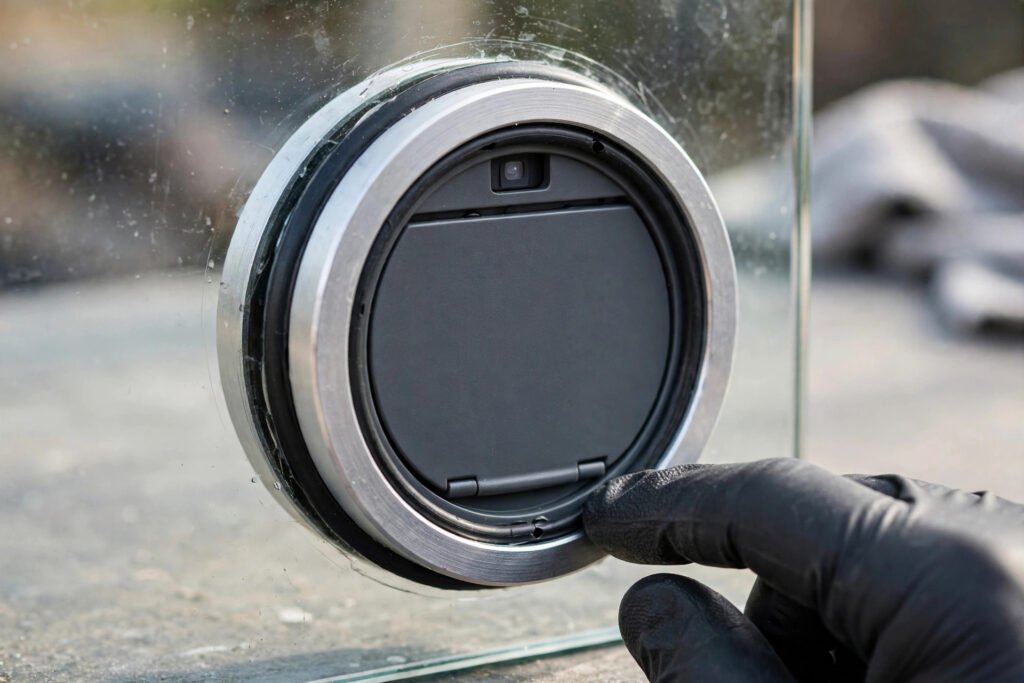
Cat flaps are square, so owners reasonably expect the hole in the glass to be square too. In glass, it never is. Every flap we mount in a glass panel goes through a circular cut-out, finished with a mounting adapter — and that round hole is not a quirk of one brand. It is the shape tempered glass can safely live with, and the adapter is what turns that hole into a sealed, secure fitting. A round cat flap for glass is the classic circular flap mounted through a circular opening in a glass panel.
See our guide to double-glazed glass pet doors for the full service.
A square flap does not mean a square hole
Look at a glass-mounted flap from inside the house and you see the familiar square or rectangular flap frame. What you do not see is how it meets the glass. Behind the frame, the flap body passes through a round hole, and a pair of adapter rings — one on each face of the glass — bridge between the round opening and the flap.
This applies across the brands we fit. SureFlap and PetSafe supply glass mounting adapters for their microchip and manual glass models, and Closer Pets supplies mounting rings for its manual four-way locking models. The names differ slightly, but the principle is identical, because all of them are answering the same engineering problem.
Why corners are the enemy in tempered glass
Glass under stress behaves predictably: force concentrates at sharp internal corners. A square or rectangular hole cut into a pane has four corners, and each one is a point where the stresses running through the glass gather. In a door pane that flexes slightly every time it opens, closes, and heats and cools between the sun outside and the air conditioning inside, those corners are where a crack eventually starts.
A circle has no corners. The stress flowing around a circular hole is spread evenly around its whole circumference, with no single point carrying a concentrated load. That is why the openings made for glass cat flap installation are cut as circles, and why the same rule applies to the holes drilled for door handles and hinges in glass doors — round, always.
Cut first, tempered second
The shape is only half of the story; the timing is the other half. The circular opening is CNC-cut into the new pane before the glass is tempered, while it can still be worked. Once a pane has been tempered, it cannot be cut at all without breaking — the hole has to be part of the glass from the start. Your existing pane is never touched: it comes out whole, is stored safely, and is swapped back in 30 minutes when you move out, which keeps the whole fitting 100% rental-friendly with no landlord NOC needed.
What the mounting adapter actually does
The adapter is sometimes dismissed as a trim ring. It does three real jobs:
- It spreads the clamping load. The flap is fixed by sandwiching the glass between the two adapter rings. That spreads the fixing pressure over a wide ring of glass instead of concentrating it at screw points near the hole’s edge, which is exactly where tempered glass is least forgiving.
- It seals the opening. The rings close the gap between the round hole and the flap body, with the seal seated around the circumference. Fitted properly, that gives a weatherproof result: cooled air stays in, and heat, dust and driven rain stay out.
- It bridges glass thicknesses. Single panes and double-glazed units are different thicknesses, and adapters accommodate that difference so the same flap sits correctly in either. In a double-glazed unit, the circular opening runs through the manufactured unit and the adapter arrangement seals around it.
Remove the adapter from the equation and none of those jobs gets done: the flap would bear on the glass edge, the annulus between hole and flap would be open to the weather, and the fitting would work loose as the door moves.
Why you cannot improvise the shape
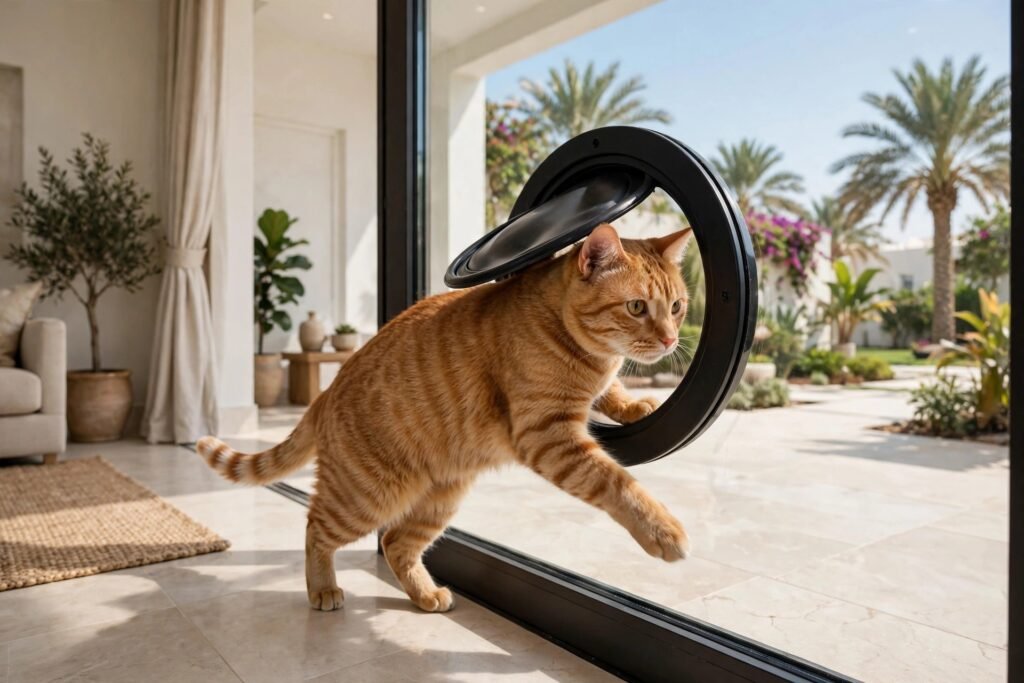
Owners occasionally ask whether a square hole could be cut with rounded corners as a compromise, or whether an existing square opening in a wall-style flap arrangement can be adapted. In glass, the answer remains the manufactured route: a circular CNC cut-out made before tempering, in a new pane, with the correct adapter for the flap model. There is no on-site version of this work, because the glass in your door is already tempered and cannot be cut on site at all.
This is also why flap model and size are agreed before the pane is made. The diameter of the circular cut-out is set by the flap and its adapter, so changing models after the glass is produced can mean a different hole — and a new pane.
Sizing: the hole follows the cat
The size rule is the same one we apply everywhere: any cat over 4 kg needs a Large flap. That covers most British Shorthairs, Ragdolls, Maine Coons and well-built adult Arabian Maus. A Large flap and its adapter need a larger circular cut-out than a standard flap, which is another reason the cat’s size is settled at the measuring visit, before anything is manufactured.
Breed and weight are a better guide here than the flap’s headline dimensions, because the usable opening is only part of the story — a broad-shouldered cat needs clearance at the size it actually is, not the size the box assumes. If your cat is still growing, tell us, and we will size for the adult it will become.
One further point for reflective or tinted villa glass: the replacement pane is matched as closely as possible to your existing shade, but a 100% identical reflective shade cannot be guaranteed, because the original glass came from a project-specific batch. We raise that before the panel is made, so there are no surprises at fitting.
Frequently asked questions
Why is the hole round when the flap is square?
Because corners concentrate stress in glass and become the starting point for cracks. A circular hole spreads stress evenly around its edge, and the adapter bridges between the round opening and the square flap frame you see from indoors.
What does a glass mounting adapter do?
It sandwiches the glass between two rings to spread the fixing load, seals the gap between the round hole and the flap so the fitting is weatherproof, and adapts the flap to the thickness of a single pane or a double-glazed unit.
Do all brands need an adapter in glass?
Yes. SureFlap and PetSafe adapters serve their microchip and manual glass models. Closer Pets rings serve its manual four-way locking models. The part names vary; the job they do is the same.
Can the circular hole be cut into my existing door glass?
No. Existing door glass is tempered and breaks if cut after tempering. The circle is CNC-cut into a new pane before tempering. Your original pane is removed whole, stored safely and swapped back in 30 minutes at move-out.
Does a bigger cat mean a bigger hole?
Yes. Cats over 4 kg need a Large flap, and the Large flap’s adapter sets a larger circular cut-out. That is decided when we measure, before the replacement pane is manufactured.
Talk to us about a flap in glass
WhatsApp us on +971 52 443 2655 with a photo of the glass door or panel and your cat’s breed and approximate weight, and we will confirm the right flap, adapter and cut-out size. You can also email admin@petdoorfix.com. We fit flaps in glass across all seven UAE emirates, and we will confirm the glass type and the plan before any panel is made. Fitted with the right adapter, a round cat flap for glass sits as neatly as any panel-mounted flap.
Instant WhatsApp Photo Quote
Send a photo of your door, your pet's size, and your area.
WhatsApp Photo QuoteNext guide: Moving Out or Selling Your UAE Villa? Restoring Your Original Patio Glass in 30 Minutes