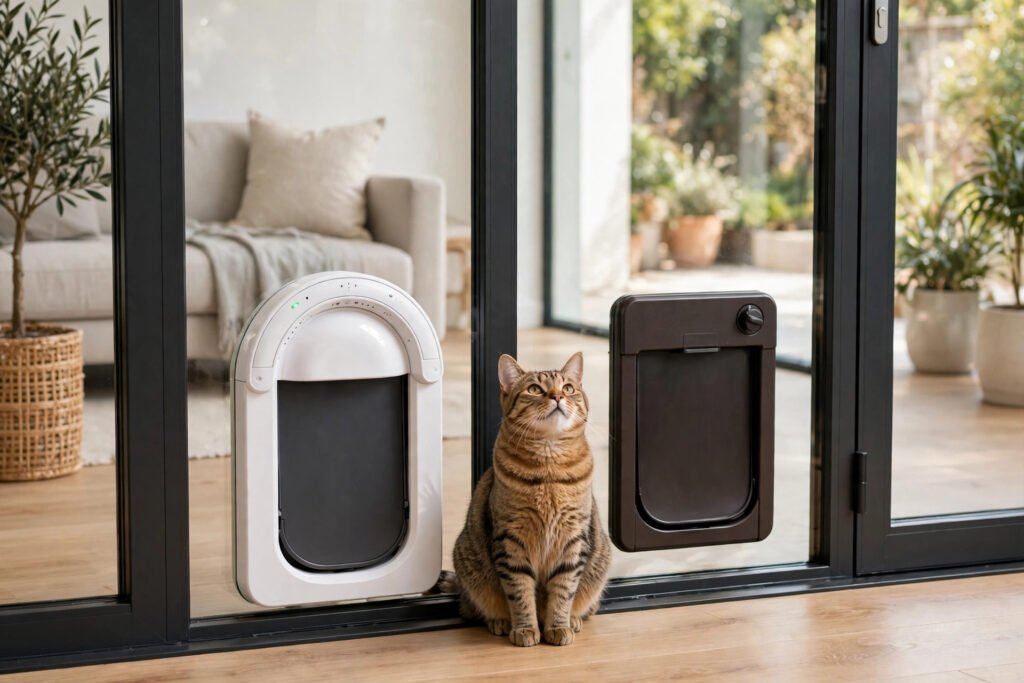
Not every home needs technology in its cat flap, and pretending otherwise would be poor advice. The microchip vs manual cat flap decision is really a decision about your household: who is trying to get in, who must stay in, and how much control you actually need. Our overview of the microchip or manual cat flap options we fit sets out the range; this article compares the two approaches honestly, household by household, so you can match the flap to your life rather than to a sales pitch.
The microchip vs manual cat flap basics
A manual four-way locking flap is the classic design, refined over decades. It has no reader and no batteries. Its four settings let you choose, by hand, between open both ways, in only, out only, and fully locked. Any cat who reaches it when it is set to open can use it. That simplicity is its strength and its limit in a single sentence: the flap obeys the setting, not the cat.
A microchip flap adds identity to the doorway. SureFlap makes microchip models that read the 15-digit ISO FDX-B chip your vet has already fitted, and PetSafe makes microchip models that work on the same principle. The flap stays locked to every animal except the cats registered to it, and it makes that decision itself, on every visit, without you touching a setting. Some microchip models add programmable control such as curfew timing or different rules for different cats, but the core difference is selective entry.
A note on brands, kept straight
SureFlap and PetSafe each make microchip flaps and also make manual flaps. Closer Pets is a different case: it makes manual four-way locking flaps only. That is not a criticism — a well-made manual flap from a specialist maker is exactly right for some homes — but it means brand and technology are separate choices. Choose the technology your household needs first, then the model within it.
Where the manual flap genuinely wins
On a quiet street with no stray problem, for a single confident cat and owners who are home most of the day, a manual flap is a perfectly good answer. There is nothing to power and nothing to register. The four-way lock gives you the controls most people actually use: locked at night, open in the day, in-only when you need the cat home for a vet appointment in the morning.
A manual flap also suits temporary situations well: a foster cat staying for a few months, a kitten too young to be chipped, or a door due to be replaced next year. And because cats over 4 kg need a Large flap whichever technology you choose, a big cat is not a reason in itself to go microchip.
The catches to weigh honestly
The manual flap’s weakness is that its settings are blunt. In-only still admits every cat who wants in, not just yours. Locked means your cat is locked too, on whichever side she is. And the system depends on a human remembering to change the setting — the night you forget is, reliably, the night a stray discovers the kitchen.
Where the microchip flap earns its place
The microchip case starts with selective entry. If strays or neighbours’ cats are visiting through an existing flap, following your cat in for food and shelter, no manual setting fixes that, because the problem is identity, not timing. A microchip flap solves it at the level it happens: registered cats pass, everything else meets a locked door, at three in the afternoon as reliably as at three in the morning.
It also suits households with different rules for different cats. An indoor cat recovering from an operation, or a kitten who must not roam yet, can be treated differently from a seasoned adult on models with per-cat control, while a manual flap must give every cat the same rule. Busy owners, frequent travellers and anyone whose cat keeps hours the household does not will value a flap that manages itself. The trade-offs are real but modest: batteries to keep an eye on, a chip to register, and a cat who must be microchipped — which, in the UAE, most cats already are through their vet.
Two households, two right answers
Picture a villa with a known stray population, three cats, and owners who travel for work: microchip is the clear choice. Now picture a ground-floor flat, one cat, a quiet courtyard with no other cats in evidence, and owners who work from home: a four-way manual flap gives them every control they will ever use. Neither household is wrong; the flap should follow the household.
Fitting is the same either way
Whichever technology you choose, the installation story in glass is identical, which means you are free to decide on the household question alone. The flap is fitted into a made-to-measure replacement glass panel; your original glass is stored safely and swapped back in 30 minutes when you move out, so the choice is 100% rental-friendly with no landlord NOC needed. With reflective glass, we will tell you plainly that a shade match cannot be guaranteed 100%.
In a sliding door, either type can sit in a track insert, available as a same-day sliding insert if booked before 10 AM with the standard white aluminium frame and clear glass, with custom RAL powder-coating taking 2–3 days. Choosing well first is cheaper than choosing twice.

Frequently asked questions
Is a microchip flap always better than a manual one?
No. It is better at one specific job — admitting only your cats — and it manages itself without daily setting changes. A home with no stray visitors and owners happy to work a four-way lock may never need it, and a manual flap will serve that home well for years.
Can a manual flap keep stray cats out?
Only by being locked, which locks your cat too. Manual settings control direction and timing, not identity, so a manual flap set to let your cat in will let any cat in. Keeping strays out while your cat comes and goes is precisely the microchip flap’s job.
Is every Closer Pets flap manual?
Yes. Closer Pets makes manual four-way locking flaps only, so its range represents the manual side of this comparison. Chip-reading models come from the other brands we fit. If a manual flap suits your home, a Closer Pets four-way model is a sound example of that type.
My cat is not microchipped. Does that settle the choice?
Not necessarily. A vet can fit the standard ISO FDX-B chip in a routine visit, after which the full microchip range is open to you. If you would rather not chip your cat, a manual four-way flap is the natural choice, with its settings managed by hand.
Can I start manual and upgrade to microchip later?
Yes. Because the flap sits in a replacement panel or insert rather than in your original glass, upgrading later is a fitting job, not a building job. Many owners start manual in a quiet area and upgrade if a stray problem develops.
Talk to us and choose once, properly
If you are still weighing microchip vs manual cat flap options for your home, WhatsApp us on +971 52 443 2655 with a photo of the door or glass panel, your cat’s breed and approximate weight, and a line about your neighbourhood and routine, and we will give you a straight recommendation — including if the honest answer is the simpler flap. You can also email admin@petdoorfix.com. We fit both types across all seven UAE emirates.
Instant WhatsApp Photo Quote
Send a photo of your door, your pet's size, and your area.
WhatsApp Photo QuoteNext guide: Keeping Indoor Cats In While Others Go Out: Selective-Exit Microchip Flaps